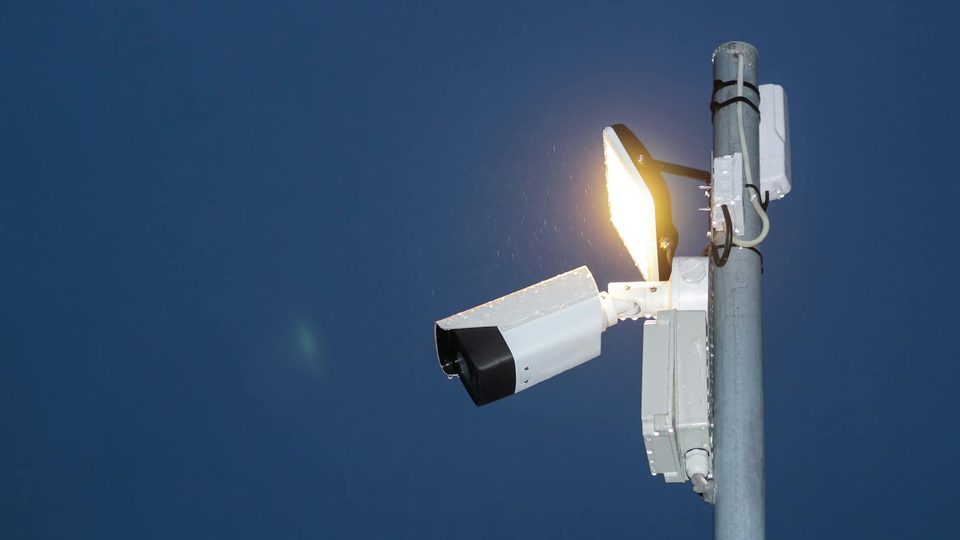
Radar and camera surveillance are often compared as if they are competing answers to the same requirement. In practice, the better comparison is by strengths, limitations, and use cases. Radar is usually the search-and-track layer. Cameras are usually the confirmation-and-interpretation layer.
That difference is one reason many security systems use both.
What Each Sensor Sees
Radar measures reflected energy from a physical object. It is usually good at telling the system that something is present, where it is, and how it is moving.
A camera measures light or thermal contrast from the scene. It is usually better at helping an operator answer the human question: what am I actually looking at?
NASA’s work on fused optical-radar tracking and EO/IR surveillance requirements is useful because it shows that these two sensing families solve different operational subproblems, even when they are pointed at the same target.
Radar Strengths and Typical Use Cases
Radar is usually stronger when the site needs:
- broad airspace search,
- continuous sector watch,
- range and motion information,
- and earlier cueing over a larger volume.
That makes radar attractive as the first detector, especially when the sensor must watch a large area without knowing in advance exactly where the target will appear.
Camera Strengths and Typical Use Cases
Cameras are usually stronger when the system needs:
- visual confirmation,
- evidence capture,
- classification support,
- and operator understanding.
A visible camera may help with markings, shape, and scene context. A thermal camera may help in darkness or in scenes where heat contrast matters. But camera performance is strongly dependent on line of sight, field of view, environmental conditions, and whether the camera was pointed in the right place at the right time.
Why Camera-Only Surveillance Often Looks Better on Paper Than in Operation
Camera-only designs are attractive because the output is intuitive. Operators like imagery, and decision makers can immediately understand what a camera produces. But wide-area search is where camera-only architectures often begin to struggle.
A narrow field of view gives more detail but covers less sky or ground. A wide field of view covers more area but gives less target detail. If the system does not already know where to look, the camera may be technically capable yet still operationally late. This is one reason visual quality alone is a poor proxy for surveillance effectiveness.
Why Cueing Matters So Much
The biggest design lesson is that cameras become far more useful when they are cued.
NASA’s 2021 fused optical-radar tracking study compared radar-only, vision-only, and fused trackers, and showed that combining radar and image detections can improve tracking continuity relative to radar alone in the tested setup. The lesson is not that every radar-camera pair will achieve the same numbers. The lesson is that handoff quality matters.
In practical terms, a radar hit can tell the system where to point a camera. That allows the camera to do what it does best without forcing it to search the whole sky by itself.
What Makes Radar-to-Camera Handoff Work
The value of combining radar and cameras depends less on the word “fusion” and more on whether the handoff is engineered well.
Good handoff usually depends on:
- enough radar track stability to keep the camera pointed in the right region,
- accurate coordinate alignment between sensors,
- update timing that does not lag behind the target maneuver,
- and a user interface that shows the operator why the camera was cued.
If those pieces are weak, the system may contain both sensors and still feel disconnected in operation.
A Practical Comparison Table
| Operational task | Radar tendency | Camera tendency |
|---|---|---|
| Initial search | Strong | Usually weak unless the search area is narrow |
| Track continuity | Strong | Can work, but depends on stable visual lock |
| Classification and evidence | Limited by itself | Stronger |
| Dependence on lighting | Low | High for visible cameras; lower for thermal |
| Dependence on correct pointing | Moderate | High |
This table is a design-oriented synthesis rather than a claim from one product test.
The Main Limitations of Each Approach
A camera-only design may offer good imagery but weak search behavior over a large area. A radar-only design may offer good awareness and tracking but weaker interpretation.
This is why the operational comparison should usually be framed as:
- radar for finding and following,
- camera for confirming and understanding.
How to Choose for a Real Project
If the site needs broad-area search with uncertain approach paths, radar usually deserves first priority. If the scene is narrow, predictable, and the main problem is confirmation or evidence capture, cameras may carry more of the burden. Most mixed environments end up using both because search and interpretation are separate jobs.
What matters in procurement is not only whether both sensors are present, but whether the handoff arrives fast enough and accurately enough for the camera view to remain useful.
In other words, the project should be judged by cue quality, not by sensor count.
That is usually where the real performance difference appears in field use.
Conclusion
Radar vs camera surveillance is not mainly a matter of choosing the superior sensor. It is a matter of assigning the right job to each sensor. Radar is generally better at search and track continuity. Cameras are generally better at confirmation and interpretation. The success of the system often depends on how well radar can hand off to the camera.
Official Reading
- NASA: Ground to Air Testing of a Fused Optical-Radar Aircraft Detection and Tracking System - Useful evidence for why radar-image fusion can improve tracking continuity.
- NASA: Detect-and-Avoid Surveillance Range Requirements for Electro-Optical/Infra-Red Sensors - Helpful for understanding optical limitations related to timing, geometry, and environment.
- MIT Lincoln Laboratory: Introduction to Radar Systems - Background on why radar is well suited to search and track tasks.