What is clutter in radar? Clutter is radar return energy that is not the target you actually want to detect, but still appears on the radar and competes for attention.
In plain language, clutter is the unwanted background of radar sensing.
If the radar is looking for an aircraft, drone, or vehicle, then echoes from terrain, buildings, waves, rain, birds, or other irrelevant objects may all act as clutter. These returns can hide the target, confuse the tracker, or increase false alarms.
Why Clutter Matters So Much
Beginners often assume radar problems are mostly about signal strength. In reality, many radar problems are about separating useful echoes from everything else.
This matters especially when the target is:
- small,
- low to the ground,
- slow-moving,
- or operating in a busy environment.
In those situations, the target echo may be much weaker than the clutter around it.
Common Types of Radar Clutter
Clutter is not one thing. It comes from many different sources.
Ground clutter
Echoes from terrain, buildings, towers, hills, or other fixed objects near the radar.
Sea clutter
Echoes from the moving sea surface, especially in rough or windy conditions.
Weather clutter
Echoes from rain, snow, clouds, insects, or atmospheric effects.
Biological or environmental clutter
Birds, swarms, vegetation movement, or other natural effects.
Man-made clutter
Urban structures, wind farms, vehicles, or infrastructure that create strong or confusing returns.
How Clutter Appears to the Radar
A radar does not know by itself which echo is important. It only measures returned energy and then relies on signal processing, motion behavior, spatial patterns, and track logic to interpret what that energy might mean.
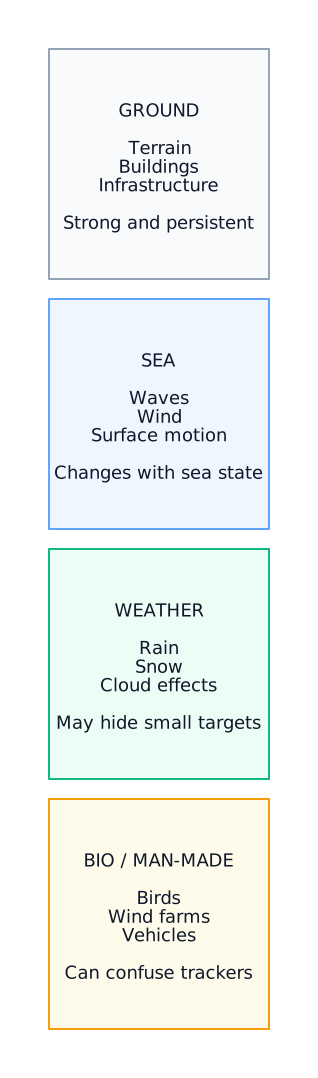
Figure: Synthesized explanatory diagram showing several common radar clutter sources. It is an educational illustration, not an operational radar display.
If clutter is strong enough, the radar may:
- miss the real target,
- show too many false detections,
- or produce unstable tracks.
That is why clutter is one of the most important practical topics in radar engineering.
Why Small Targets Struggle in Clutter
Small targets are often hardest to detect when they fly or move near strong backgrounds.
A low-altitude drone is a good example. The radar is not only looking at the drone. It may also be seeing ground reflections, buildings, trees, weather, and moving background effects in the same part of the scene.
The challenge is not merely “can the radar detect something?” The real challenge is often:
can the radar detect the target clearly enough to separate it from clutter?
Geometry Changes the Clutter Problem
Clutter is not only a signal-processing issue. It is also a geometry issue.
Radar height, beam angle, target altitude, terrain profile, and look direction all influence how much unwanted background enters the sensing problem. A radar positioned badly may face a harder clutter problem even if the hardware itself is capable.
This is why site surveys and deployment geometry matter so much in real radar programs.
How Radars Reduce Clutter
Radar systems use many methods to reduce clutter effects.
Common examples include:
- Doppler processing,
- moving target indication,
- clutter maps,
- thresholding and CFAR-style detection logic,
- beam design and geometry choices,
- and track-level filtering.
The exact method depends on the radar mission and environment. A maritime radar faces a different clutter problem from a low-altitude site radar or a weather radar.
Clutter Reduction Is Always a Trade-off
Beginners sometimes imagine that clutter is just “noise” and software should remove it cleanly. Real clutter is more difficult than that.
If filtering is too aggressive, the radar may suppress real targets along with the unwanted background. If filtering is too weak, false detections rise and operators lose trust.
So clutter mitigation is always a balance between sensitivity and selectivity. The radar must reject enough unwanted energy to remain useful without becoming blind to the kinds of targets the mission actually cares about.
Clutter vs Noise vs Interference
These terms are related but not identical.
- Noise is usually random unwanted signal energy inside the receiver chain or environment.
- Clutter is usually unwanted echoes from real objects or environmental structures.
- Interference is usually energy from other emitters or electronic sources that disrupt the radar’s measurement process.
That difference matters because each problem is managed differently. A system that handles receiver noise well may still struggle badly with ground clutter or with external interference.
Why Clutter Can Never Be Removed Perfectly
Clutter changes with:
- terrain,
- weather,
- wind,
- antenna angle,
- sea state,
- season,
- and local infrastructure.
Because the background changes, clutter performance has to be evaluated under realistic conditions rather than assumed from a static laboratory example.
Why Site Tuning and Clutter Maps Matter
Many practical radar deployments rely on local tuning, clutter maps, or background models that are built from the site itself. That is because a radar installed near water, rooftops, or dense infrastructure may face a clutter picture that is very different from its nominal test environment.
This is another reason clutter is not a minor option. It is part of the real deployment engineering.
A Good Beginner Mental Model
The easiest way to think about clutter is this:
it is the radar’s unwanted background picture.
The better the radar is at managing that background, the easier it becomes to find the target that actually matters.
That is also why clutter problems quickly become operator problems. If unwanted background is not managed well, the system may still be working technically while becoming much harder to use operationally.
In that sense, clutter management is part of usability, not only signal processing.
Official Reading
- NOAA National Severe Storms Laboratory: Radar FAQ - Helpful official background on how radar sees weather and environmental returns.
- National Weather Service Glossary: Clutter - Useful concise official definition of clutter in radar practice.
- MIT Lincoln Laboratory: Introduction to Radar Systems - Good foundational reference for why target detection always depends on more than raw signal strength.