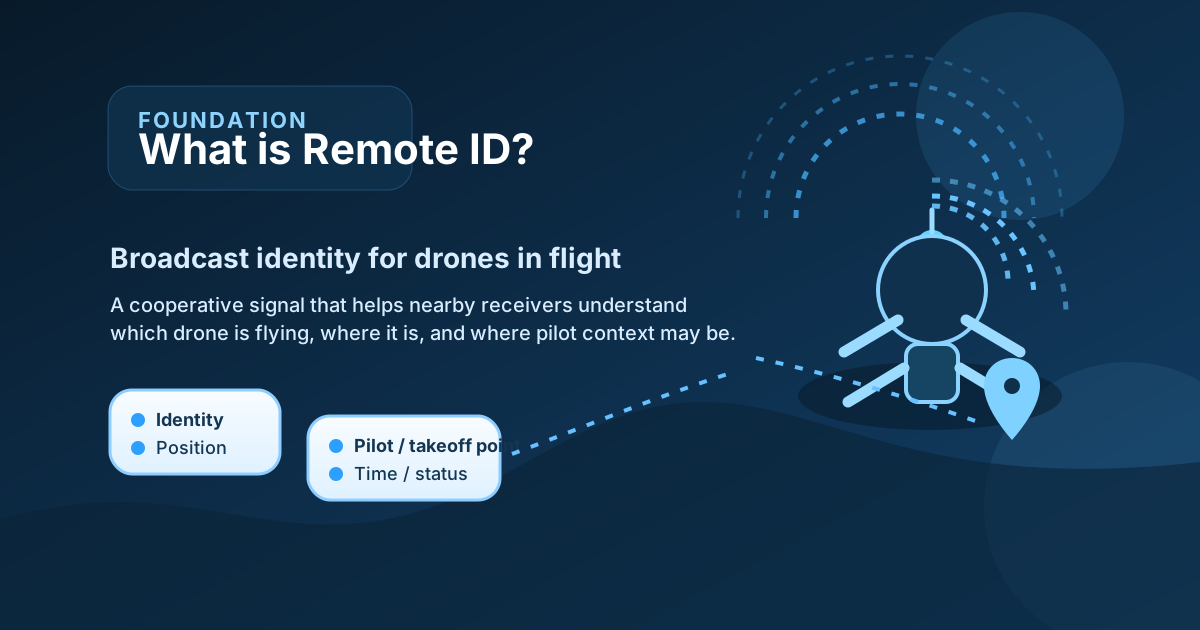
What is Remote ID? In simple terms, Remote ID is a way for a drone in flight to broadcast who it is and where it is. Many people describe it as a digital license plate for drones, but that shorthand is only partly right. A license plate tells you that a vehicle can be identified. Remote ID goes a little further by adding real-time flight information that can help safety, accountability, and airspace awareness.
That is why Remote ID matters to several different groups at once. Regulators need a workable way to support more drone activity without making low-altitude airspace unmanageable. Public-safety teams and enforcement agencies need a way to understand who may be operating a drone in a sensitive area. Operators need a compliance path for legal flights. And nearby people often want a clearer answer to a basic question: whose drone is this, and should it be here?
The exact rules are not the same everywhere. In the United States, the FAA defines Remote ID as the ability of a drone in flight to provide identification and location information through a broadcast signal. In Europe, EASA uses the closely related term direct remote identification, with rules that tie it to drone classes, operator registration, and future U-space services. So the details vary by jurisdiction, but the beginner-level idea is stable: Remote ID is a broadcast identification layer for drones, not a full traffic-management system by itself.
What Remote ID Actually Broadcasts
To understand Remote ID, start with the data rather than the regulation. A Remote ID-enabled drone is designed to emit a short set of flight-related information that nearby authorized or general-purpose receivers can pick up, depending on the system and the jurisdiction.
In broad terms, a Remote ID transmission may include:
- a drone or module serial number, or another approved identifier,
- the aircraft position,
- altitude or height reference,
- velocity or movement direction,
- a time mark,
- and either the control-station position or the takeoff position, depending on how the system is implemented.
In the FAA’s Standard Remote ID model, a compliant drone broadcasts information about the drone and the control station. FAA materials also show that the message can include the drone serial number, drone position and altitude, velocity, control-station location and elevation, a time mark, and emergency status. In the European direct remote identification framework, EASA materials describe a broadcast that can include the operator registration number, the drone serial number, the drone location, route course and speed, and the remote pilot position or, if that is not available, the takeoff point.
That list shows why Remote ID is more than a simple registration sticker. It is not just saying, “this aircraft belongs to operator X.” It is creating a live, nearby data signal that can support accountability while the aircraft is actually flying.
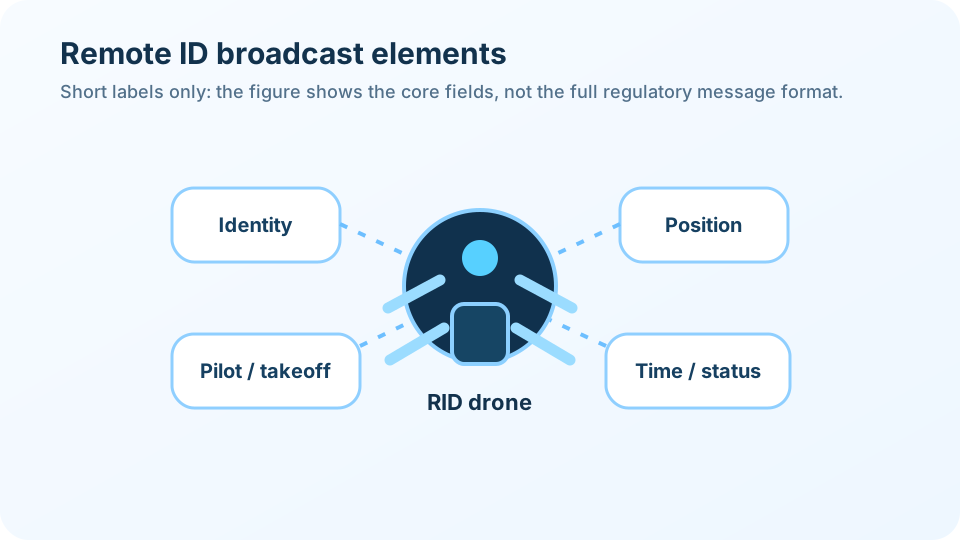
Figure: Synthesized explainer showing the main Remote ID data elements in a beginner-friendly way. The exact message set depends on the regulatory framework and implementation path.
This is also a good place to clear up an easy misunderstanding. Remote ID is not the same thing as putting a drone on the internet. In most public explanations, the core idea is local broadcast rather than constant cellular backhaul. The signal is intended to be receivable in the nearby operating environment. That matters because the goal is immediate local awareness and accountability, not only cloud reporting after the fact.
Why Regulators Want Remote ID
The beginner question is often, “Why was this added at all?” The answer is that drone operations scaled faster than traditional low-altitude oversight methods were designed for.
When only a small number of drones are flying in simple places, many situations can still be handled through pilot skill, visual observation, local procedures, and occasional enforcement. But as drone operations become more common near cities, infrastructure, events, logistics routes, and public venues, the airspace problem changes. Now the system needs more routine visibility into who is operating, what is flying, and whether a flight appears cooperative or suspicious.
The FAA states that Remote ID lays the foundation for the safety and security groundwork needed for more complex drone operations. That wording matters. Remote ID is not presented as the whole solution. It is presented as groundwork. EASA makes a similar point from a different angle: remote identification improves transparency and accountability, and it also supports future U-space services. In both frameworks, the same message appears beneath the wording: routine drone integration needs some form of routine digital identification.
This is why Remote ID has value even outside strict enforcement scenarios. It can help reduce uncertainty. A compliant aircraft that is broadcasting the expected data is easier to classify than a silent airborne object near a restricted or sensitive area. That does not automatically make the flight safe or authorized, but it gives the ecosystem a cooperative signal to work with.
The Main Compliance Paths
One reason the topic confuses beginners is that “Remote ID” can describe both the function and the compliance route. The function is the broadcast of identification and flight information. The compliance route is how an operator reaches that state under a given rule set.
In the United States, the FAA presents three practical paths:
- Fly a Standard Remote ID drone with built-in capability.
- Attach a Remote ID broadcast module to a drone that did not originally have built-in Remote ID.
- Fly without Remote ID only inside a FAA-Recognized Identification Area, or FRIA, under the relevant operating limits.
Those paths are not equal. A standard Remote ID drone provides the full built-in broadcast path. A broadcast module is a retrofit path, but it may have operational limits. FAA materials explain that a drone using a broadcast module reports the drone location and the takeoff location, and that pilots using such a module must keep the aircraft within visual line of sight. A FRIA is different again: it is not a technology fix but a geographically bounded operating exception for aircraft that do not have Remote ID equipment.
In Europe, the logic is framed somewhat differently. EASA focuses on drones equipped with direct remote identification according to class and operating category, and it also allows add-on modules in some cases. The details differ, but the beginner lesson is the same: Remote ID compliance is not one universal hardware path. It is a regulatory pathway that depends on the aircraft, the operating category, and the local rule set.
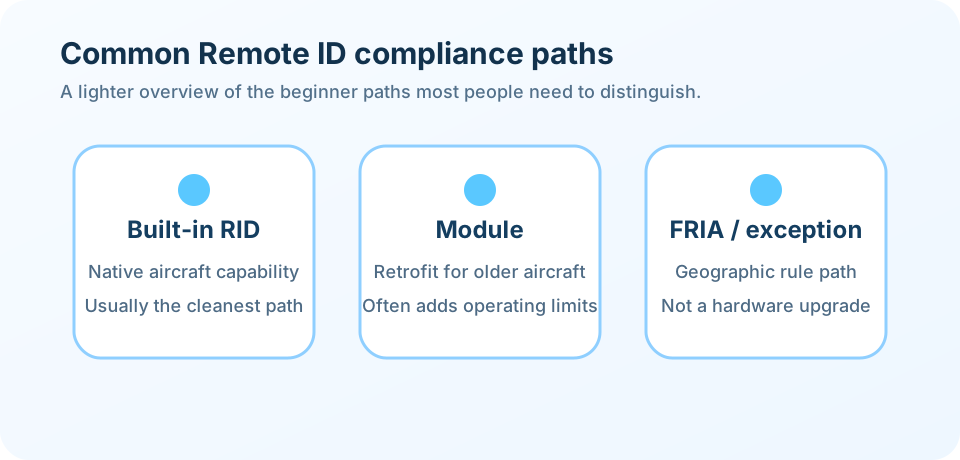
Figure: Synthesized compliance overview showing the three common beginner mental models: built-in Remote ID, retrofit module, and geographically limited exceptions.
What Remote ID Helps With, and What It Does Not Solve
Remote ID is useful, but it is easy to expect too much from it. A strong beginner article has to explain both sides.
What Remote ID helps with:
- cooperative identification of compliant drones,
- faster awareness for nearby authorities or approved receivers,
- stronger accountability than anonymous visual observation alone,
- and a better foundation for future traffic-management and deconfliction services.
What Remote ID does not solve by itself:
- it does not prove that a flight is authorized,
- it does not replace airspace approval or mission-specific rules,
- it does not replace radar, RF detection, or optical confirmation,
- and it does not make a silent, non-compliant, modified, or intentionally evasive drone disappear as a security problem.
That last point is especially important for security and counter-UAS readers. Remote ID is helpful when the aircraft is cooperative and broadcasting correctly. It becomes less useful when the aircraft is non-compliant, deliberately altered, or simply outside the specific compliance class that the observer expects. So Remote ID is valuable, but it should be treated as one layer in a broader awareness system.
This is also why Remote ID should not be confused with general drone detection. Detection answers the question, “Is there something in the air?” Remote ID answers the narrower question, “Is there a cooperative identity broadcast I can use?” Those are different questions, and a site that mixes them together can make poor security decisions.
How Remote ID Relates to UTM and U-space
Many beginners encounter Remote ID and UTM at roughly the same time, then assume they are interchangeable. They are not.
Remote ID is a broadcast identification layer. UTM, or unmanned aircraft system traffic management, is a broader operating concept for managing many drone flights at low altitude. In Europe, U-space is the regulatory and service framework used for that same broad problem. So Remote ID is a component that can support traffic-management ecosystems, but it is not the full ecosystem.
The relationship is easier to understand this way:
- Remote ID helps answer who and where.
- UTM or U-space helps answer how multiple operations are coordinated safely.
FAA materials explicitly say that Remote ID lays the groundwork for more complex operations. EASA materials explicitly connect remote identification to future U-space services. That connection is real, but beginners should be careful not to jump too far. A drone can broadcast Remote ID without the surrounding airspace having mature, fully automated drone traffic management. Remote ID is one building block, not the whole building.
Common Misunderstandings About Remote ID
Several misconceptions show up again and again.
“If a drone has Remote ID, the flight must be legal”
No. Remote ID shows that the aircraft is broadcasting the required identification data for that framework. It does not automatically confirm that the operator has the right authorization, is in the right airspace, or is following every applicable operating limit.
“Remote ID replaces all other detection technologies”
No. Remote ID is only useful when the aircraft is broadcasting in a compliant and receivable way. Physical sensing layers such as radar, RF detection, and EO / IR still matter because not every aircraft will be cooperative, visible, or easy to classify from one source alone.
“Remote ID lets everyone know the pilot’s full identity”
Usually not in the simple public sense people imagine. Public-facing systems may receive broadcast data, but linking an identifier to a named individual is generally controlled by the relevant regulatory and enforcement framework. EASA, for example, makes clear that public users can detect the remote identification information, but enforcement authorities are the ones able to associate the registration number with a name through the database.
“Remote ID means every drone can be tracked everywhere”
No. Coverage depends on the type of receiver, the transmission method, the environment, and whether the aircraft is actually transmitting the expected information. Remote ID is helpful, but it is not magic infrastructure that guarantees universal visibility.
“Remote ID is only a regulatory burden”
That view is too narrow. It is true that operators experience Remote ID as a compliance requirement. But the broader policy logic is that routine drone operations become easier to scale when the ecosystem has a basic cooperative identification layer. Without that layer, every higher-volume or more complex operation becomes harder to supervise, justify, and integrate.
What This Means in Practice
For a beginner, the most practical way to think about Remote ID is as a cooperative airspace signal.
If you are a drone operator, the first question is compliance: which rules apply to your aircraft and mission, and what broadcast path is accepted in your jurisdiction? If you are a security planner, the first question is interpretation: can your workflow distinguish a cooperative broadcast target from an unknown airborne object? If you are thinking about the future of low-altitude operations, the key point is architectural: Remote ID is one of the enabling layers that makes higher-tempo drone traffic more manageable.
That is also why good articles do not oversell it. Remote ID is not a complete security shield, and it is not a full traffic-management platform. But it is a meaningful step toward a more accountable low-altitude environment. For compliant operators, it provides a path to identification. For regulators, it provides a baseline digital layer. For the wider ecosystem, it reduces at least some of the anonymity that made early drone integration harder.
Conclusion
Remote ID is the broadcast identification layer that helps drones become more accountable in flight. It tells nearby receivers useful information about the aircraft and, depending on the framework, about the control station or takeoff point. That makes it important for compliance, transparency, and future traffic-management concepts.
The key beginner takeaway is simple: Remote ID matters, but it is not the whole answer. It helps identify cooperative drone activity. It does not replace authorization checks, traffic coordination, or broader detection systems. The most accurate mental model is to treat Remote ID as one important layer in a larger low-altitude safety and awareness stack.