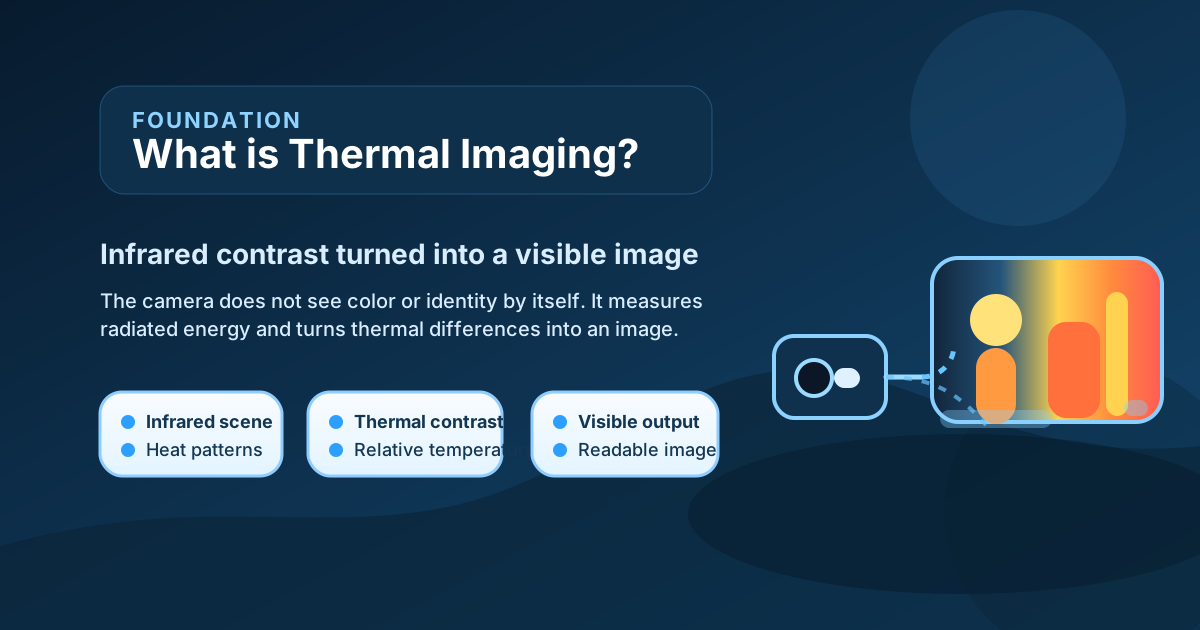
What is thermal imaging? In simple terms, it is a way of creating an image from differences in infrared radiation rather than from ordinary visible light. A thermal camera does not work like a normal daylight camera. Instead of mainly recording reflected visible light, it senses heat-related infrared energy and turns those differences into a visible picture that humans can interpret.
That is why thermal imaging is often described as making the invisible visible. NASA’s infrared-wave material explains that hotter objects emit more infrared energy, and that the thermal-infrared region is especially useful for studying emitted thermal energy. A thermal camera uses that principle in a practical way. It detects infrared radiation and converts it into an image where warmer and cooler areas appear different from one another.
For beginners, the most useful starting point is this: thermal imaging is about temperature contrast and infrared emission, not ordinary color or visible texture. That makes it powerful in darkness, in glare-heavy conditions, and in cases where a visible camera may struggle to separate a subject from the background. But it also creates limitations that beginners often misunderstand, especially around glass, reflections, emissivity, and the myth that thermal cameras can automatically see through solid barriers.
What Thermal Imaging Actually Detects
Thermal imaging starts with the physics of infrared radiation.
Objects above absolute zero emit electromagnetic radiation, and part of that radiation can fall in the infrared region. NASA’s educational material on infrared waves explains that hotter objects emit more infrared energy and that thermal infrared wavelengths are especially useful for observing emitted heat. In practical imaging systems, this means a scene contains invisible energy differences even when the visible scene looks dark, hazy, or visually plain.
A thermal camera is designed to detect those differences. FLIR’s public explanations describe thermal imagers as converting infrared radiation into a visible image that represents temperature variations across a surface. That is a good beginner definition because it links the physics to the image. The camera is not showing the scene the way your eyes see it. It is mapping differences in infrared energy into a picture you can read.
This also explains why thermal imaging is not the same as “night vision” in the broad popular sense. Some night-vision systems amplify small amounts of visible or near-visible light. Thermal imaging is different. It uses infrared energy emitted by the scene itself.
How a Thermal Camera Works
The mechanism is easier to understand if you break it into steps.
First, infrared energy from the scene reaches the camera. Then optics and the sensor respond to those infrared differences. The camera electronics convert the detected signal into a processed image, often with grayscale or false-color mapping so that warmer and cooler regions are easier for a human operator to interpret.
NASA’s thermography overview explains that thermal information can be rapidly collected over a wide surface area using an infrared camera. NASA’s Landsat TIRS instrument description gives the deeper principle: more thermal energy hitting the detector material creates a stronger electrical signal, which is then calibrated and turned into a usable temperature-related image. The instruments differ, but the beginner lesson is the same. The camera turns infrared energy into an electrical signal and then into a human-readable image.

Figure: Synthesized workflow showing how infrared energy from a scene becomes a visible thermal image after detection, conversion, and image processing.
This is also why thermal imaging often works well in complete darkness. Visible light may be absent, but the scene can still emit usable infrared energy. A person, vehicle, warm roof, machine, or recently heated surface may stand out clearly even when the visible image is poor.
Why Thermal Imaging Helps
Thermal imaging is useful because it can reveal contrast that visible cameras miss.
If two objects look similar in visible light but are at different temperatures, a thermal camera may separate them clearly. That is why thermal imaging is used in inspection, search and rescue, perimeter observation, industrial monitoring, building diagnostics, and many scientific applications.
NASA’s thermography page gives a good practical example. It explains that thermal information can highlight hotspots, thinning materials, and internal flaws because heat flow is affected by underlying conditions. This shows a broader truth: thermal imaging is often valuable not because it shows more detail in the visible sense, but because it shows a different kind of information.
In security or observation work, that can mean a person standing out against a cooler background at night. In maintenance work, it can mean overheated equipment standing out against normal hardware. In science or remote sensing, it can mean surface temperature patterns that visible imagery cannot show directly.
What Thermal Imaging Can and Cannot Tell You
Beginners often make one of two opposite mistakes. Some expect thermal imaging to do almost everything. Others assume it only produces vague heat blobs. Both are incomplete.
What thermal imaging can often tell you:
- where stronger or weaker heat signatures appear,
- where abnormal temperature contrast may exist,
- where a target is easier to separate from the background than in visible light,
- and where surface-temperature patterns may indicate a condition worth further investigation.
What thermal imaging does not guarantee by itself:
- exact material identity,
- full target identification,
- the internal condition of an object without interpretation,
- or the ability to see through every obstacle.
This is especially important because public misconceptions about thermal imaging are common. FLIR’s public FAQ explains directly that thermal imaging cannot see through walls. In some cases infrared can pass through materials such as certain plastics, but ordinary walls, wood, metal, and many common barriers block or distort what the camera can measure. So a thermal image is not magic x-ray vision.
Glass is another famous beginner trap. To the eye, glass seems transparent, but to many thermal cameras it can behave more like a reflective surface than a clear window into the scene beyond. A beginner who does not understand that can misread reflections as if they were temperatures behind the glass.
What Changes the Image You See
Thermal imaging is powerful, but interpretation depends on several factors.
Emissivity
Not every surface emits infrared energy in the same way. Emissivity affects how strongly a surface emits compared with an ideal emitter. This matters because two objects at the same physical temperature may not look identical if their surface properties differ. A good-looking thermal image is not always a simple direct temperature truth.
Reflections
Some surfaces reflect infrared energy from other sources. That means the camera may be seeing a mixture of emitted and reflected energy. A shiny surface can therefore mislead the user if they assume the image is showing only the object’s own temperature.
Atmosphere and distance
Water vapor, haze, rain, and distance can affect how much infrared energy reaches the detector. A thermal camera may still function in challenging conditions, but the image or measurement quality can change.
Focus, calibration, and camera settings
A thermal camera still needs correct optics, stable calibration, and good settings. FLIR’s calibration guidance notes that calibration links what the camera sees to known temperatures so that the camera can correctly relate detected radiation to temperature estimates. For a beginner, the main lesson is that thermal cameras are not only optics devices. They are measurement systems.
Scene geometry
The angle between the camera and the target surface can matter. So can partial occlusion, mixed backgrounds, or a target that occupies too few pixels in the image. A thermal image is still an image, which means geometry and resolution matter.
Figure: Synthesized reminder that the thermal image depends not only on object heat, but also on emissivity, reflections, atmosphere, and camera setup.
Thermal Imaging Is Not the Same as Temperature Measurement Everywhere
Another common mistake is assuming that a thermal picture automatically provides exact temperature measurement at every point with no extra care.
In some systems, thermal imaging is used mainly for contrast and detection. In others, it is used for calibrated temperature measurement, which is often called radiometric thermal imaging. Those are related, but they are not identical use cases.
NASA’s remote-sensing descriptions and NIST’s infrared thermography work both show that calibration and context matter. If the system is measuring temperature in a meaningful way, it usually depends on known sensor behavior, calibration references, scene assumptions, and correct interpretation. A pretty heat map alone is not the same as validated temperature data.
This matters in practice. A thermal camera can quickly show that one machine component is much hotter than its neighbors. That is often operationally useful even before exact temperature correction is perfect. But if the user wants defensible temperature values, then emissivity, calibration, reflected energy, and other measurement conditions become much more important.
Common Misunderstandings
Several beginner misunderstandings appear repeatedly.
“Thermal imaging sees through walls”
No. Thermal imaging usually detects surface temperature patterns and emitted infrared energy from surfaces in view. Ordinary walls are not transparent to the camera in the way this myth suggests.
“Thermal imaging works because it sees in the dark like a normal camera”
Not exactly. It works in darkness because it does not depend on visible reflected light in the same way a conventional visible camera does.
“A bright thermal image always means the object is hotter in an absolute sense”
Not necessarily. The displayed contrast depends on palette, scene settings, emissivity, reflections, and the processing choices made by the camera.
“Thermal imaging automatically identifies the target”
No. It provides useful thermal contrast. Identification usually still depends on context, resolution, target shape, range, and sometimes additional visible or other sensing layers.
“Thermal imaging replaces visible cameras”
No. Thermal and visible imaging answer different questions. Thermal helps with heat contrast and low-light separation. Visible imaging helps with color, markings, texture, and ordinary human-readable detail.
What This Means in Practice
For a beginner, the best mental model is that thermal imaging reveals heat-related contrast, not full scene truth by itself.
That is why it is so useful in darkness, glare, smoke-adjacent scenes, search tasks, inspection work, and many monitoring scenarios. It can reveal things a visible camera misses. But the same property also creates interpretation traps. A thermal image is shaped by emission, reflections, surface properties, atmosphere, calibration, and the way the camera is configured.
This is also why experienced users often combine thermal and visible imaging rather than treating them as rivals. The thermal image may reveal the target first. The visible image may then help confirm what the target actually is. In other words, thermal imaging is most powerful when its strengths and limits are both understood.
Conclusion
Thermal imaging creates a visible picture from differences in infrared radiation. It helps users see heat-related contrast that ordinary visible cameras may miss, especially in darkness or in scenes where temperature differences matter more than color and texture.
The most important beginner takeaway is simple: thermal imaging is powerful, but it is not magic. It does not automatically see through walls, prove exact temperature everywhere, or identify every target by itself. It is a distinct sensing layer that becomes most useful when you understand what it is measuring and what can distort the image.