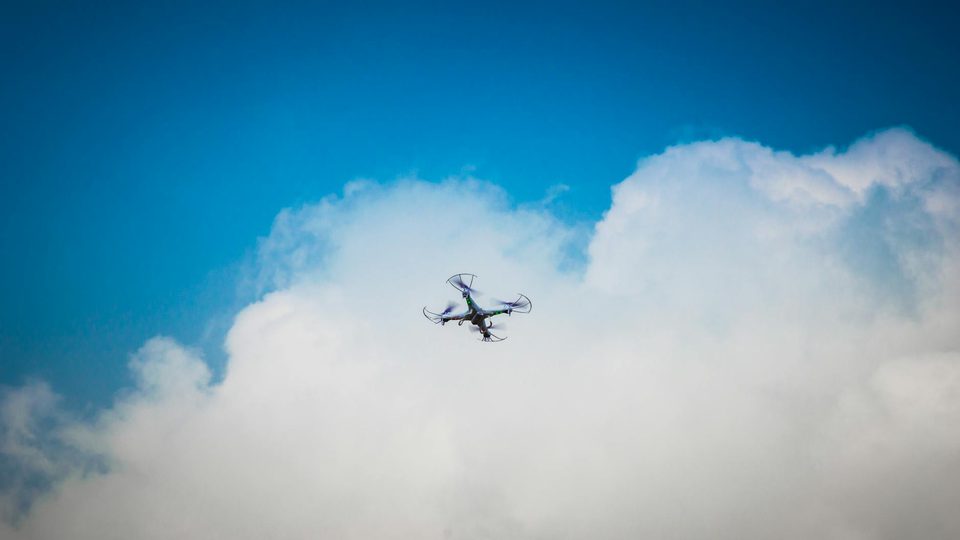
Drone detection and drone tracking are related, but they are not the same task. Understanding the difference matters because the system requirements change as soon as the mission moves from first notice to maintained awareness. Detection is the moment the system first recognizes that something relevant may be present. Tracking is the process of maintaining that object’s position, motion, and continuity over time.
In practice, a system may succeed at the first task and still struggle with the second.
Detection Is a First Notice
Detection answers a simple question: is there something here?
A radar hit, RF event, or visual cue can all count as detection if they provide enough evidence to say that a potentially relevant object or signal has appeared. Detection is important because it starts the workflow, but it does not by itself tell the operator where the object will be next or whether the event will remain stable enough to act on.
Why Tracking Changes the Engineering Problem
A system built only for first notice can tolerate more uncertainty. A system built for tracking cannot. Once tracking becomes the requirement, the architecture has to preserve continuity through imperfect measurements, target maneuvers, and brief degradations.
That means the move from detection to tracking often changes the design conversation from sensitivity alone to latency, revisit rate, measurement quality, and track-management logic.
Tracking Is a Maintained Estimate
Tracking is harder because the system has to do more than notice the target once. It has to update and maintain the target state across time.
That often means estimating:
- current position,
- movement direction,
- speed,
- confidence,
- and continuity when measurements are noisy or intermittent.
MIT Lincoln Laboratory’s recent electronically scanned radar work describes systems that can search for an object and, once it is found, keep it in track while continuing to search for additional objects. That distinction is exactly the point: tracking requires ongoing management, not just initial discovery.
System Requirements Change Once Tracking Is Needed
Once the mission requires tracking rather than only alerting, the system usually needs more than sensitivity. It needs update cadence, association logic, stable geometry, confidence handling, and enough continuity for downstream cueing or response.
It may also need a different command workflow. An isolated alert can be displayed as a simple event. A maintained track usually needs history, confidence updates, and visual cues that help the operator understand whether the event is becoming more or less credible over time.
Why Tracking Is Harder
A drone can be detected once and then become harder to maintain because of:
- low altitude and clutter,
- intermittent line of sight,
- rapid maneuvering,
- sensor latency,
- or ambiguous association with other measurements.
NASA’s fused optical-radar tracking study is useful because it focuses not only on first detection, but on maintaining continuity with combined inputs over time. That is the real operational challenge in many low-altitude environments.
A Practical Comparison
| Question | Detection | Tracking |
|---|---|---|
| Core purpose | Notice that a target may be present | Maintain target state over time |
| Minimum evidence needed | Often one credible observation | Repeated or fused observations with continuity |
| Sensitivity to latency and update rate | Moderate | High |
| Operational value by itself | Limited | Much higher |
This table is an engineering synthesis rather than a formal test metric.
Why Operators Care More About Tracking
Detection is necessary, but tracking usually creates the usable operational picture.
Once a track exists, the system can:
- cue cameras,
- estimate approach behavior,
- prioritize operator attention,
- and preserve an event history.
Without tracking, the operator may receive only isolated alerts that are difficult to interpret or escalate.
What Commonly Breaks Tracking
Tracking quality often degrades for very practical reasons:
- update intervals are too slow,
- detections drop out in clutter,
- two nearby objects become hard to separate,
- or the system cannot associate new measurements to the existing track confidently.
That is why a product claim about detection range tells only part of the operational story.
Why Some Systems Stop at Detection
Some systems remain detection-oriented because their sensing layer is strong enough to raise alerts but not strong enough to sustain a stable track under real operating conditions. That may still be useful in narrow scenarios, but it changes what the system can support downstream.
The planning error is to assume that a strong detection claim automatically implies strong tracking performance.
How to Evaluate a System Honestly
Teams should ask separately:
- how the system detects a target the first time,
- how often it updates that target afterward,
- what happens when measurements drop briefly,
- and whether the resulting track is stable enough to cue cameras or support escalation.
Those questions reveal very quickly whether a design is a detector, a tracker, or only a detector that marketing language has renamed.
That distinction protects teams from buying alerting capability when the mission actually depends on sustained track quality.
It also sets more honest expectations for operators and procurement teams.
Conclusion
Drone detection is the start of the problem. Drone tracking is the sustained solution to it. Detection tells the system that something may be there. Tracking tells the operator where it is going, how stable the event is, and whether a response path is credible. In real operations, that difference matters more than many first comparisons suggest.
Official Reading
- NASA: Ground to Air Testing of a Fused Optical-Radar Aircraft Detection and Tracking System - Useful for understanding how fused sensing supports tracking continuity.
- MIT Lincoln Laboratory: Radar and Communications System Extends Signal Range at Millimeter-Wave Frequencies - Includes a recent description of searching and then keeping a target in track while continuing surveillance.
- MIT Lincoln Laboratory: Introduction to Radar Systems - Good background for how detection and tracking differ in radar operations.