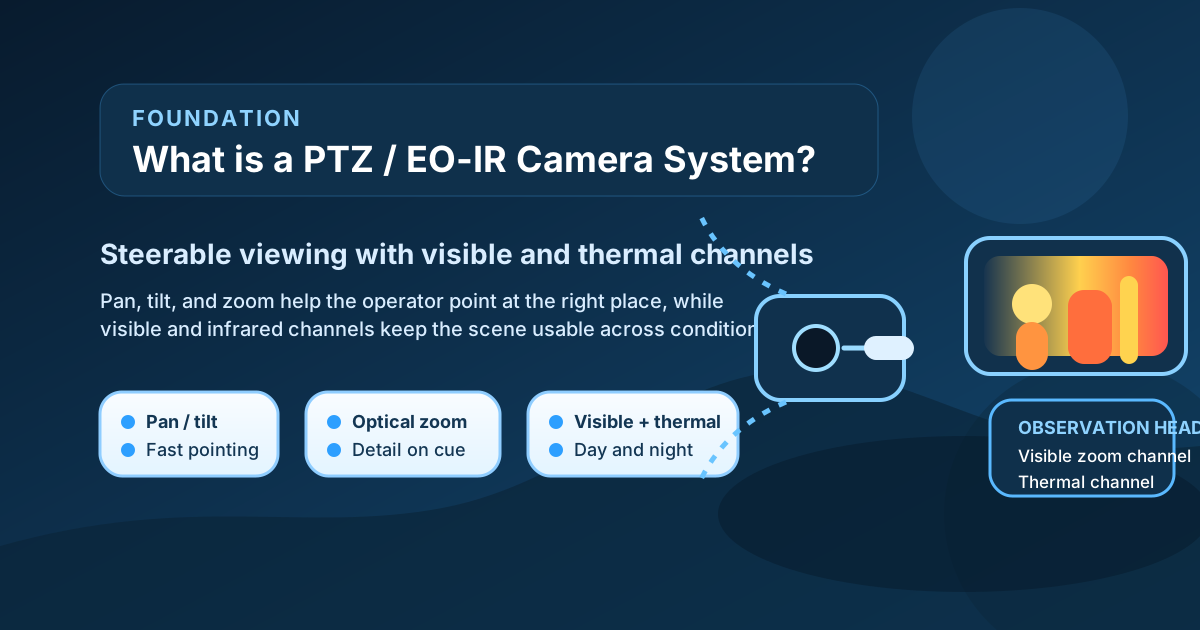
What is a PTZ / EO-IR camera system? In plain language, it is a steerable camera system that can pan left and right, tilt up and down, and zoom in on a scene while using one or more imaging channels such as a daylight camera, a low-light camera, or a thermal imager. PTZ describes the movement and viewing control. EO/IR describes the sensing payload. EO usually refers to visible or near-visible electro-optical imaging, while IR refers to infrared imaging, often a thermal channel.
That is why the phrase can feel confusing to beginners. Sometimes people use PTZ camera to mean almost any remotely steerable zoom camera. Sometimes they use EO/IR to mean a more specialized day-and-night system with both visible and infrared sensors. In practice, many surveillance products sit somewhere between those two ideas. The common thread is that the system is meant to look at a chosen part of the scene, hold that view, and give the operator more detail than a fixed wide-angle camera can provide.
The easiest way to understand the topic is to separate two jobs that surveillance systems often need to do. One job is to search a large area and notice that something is there. Another job is to point at the object, watch it more closely, and decide what it is doing. A PTZ / EO-IR camera system is usually stronger at the second job than the first. It helps with confirmation, tracking, and visual judgment after a target or area of interest has already been chosen by an operator, a radar, a fence alarm, a map cue, or analytics.
Teledyne FLIR describes EO/IR systems as imaging systems that include both visible and infrared sensors and emphasize long-range imaging and image stabilization. Axis uses similar system language in a different market segment when it describes bispectral PTZ products as combining thermal detection with visual verification, together with continuous pan and stabilization. Those details point to the same beginner lesson: this is not just a camera on a motor. It is a steerable observation head designed to keep useful imagery on target across changing light, distance, and scene conditions.
What PTZ and EO/IR Mean
Start with the two halves of the name.
PTZ means:
Pan: rotate horizontally to scan or slew toward a point of interest.Tilt: move vertically to keep the view aligned as the target or terrain changes.Zoom: change the field of view so the operator can either cover more area or inspect a smaller area in more detail.
EO/IR means:
EO: a visible-light or low-light optical imaging channel.IR: an infrared channel, often used for thermal imaging.
When these are combined in one system, the operator gains both pointing control and sensing flexibility. A daylight channel usually gives the most intuitive image for recognition, signage, and scene context. A thermal channel often gives better target contrast at night, in haze, or against difficult backgrounds where visible imagery becomes weak. Some systems can show either channel separately, while others also support picture-in-picture, side-by-side viewing, or fused overlays.
That is why beginners should not reduce the topic to “a camera that moves.” A serious PTZ / EO-IR system is closer to a controlled observation head. The important question is not only whether it can move, but whether it can keep a useful image stable and interpretable while the scene, weather, range, and lighting change.
How a PTZ / EO-IR Camera System Works
A typical system has four main layers.
The first layer is the sensor package. This may include:
- a visible daylight camera,
- a low-light or color zoom camera,
- a thermal imager,
- and sometimes a laser rangefinder, illuminator, or other helper payloads in higher-end systems.
The second layer is the motion mechanism. Motors and encoders drive pan and tilt movement, while the optics or sensor path handle zoom. Presets let the system return to known viewpoints quickly. Guard tours or automated patrol patterns can cycle through important viewpoints. More advanced systems may also support auto-tracking or cueing from another sensor.
The third layer is stabilization and image control. This is one of the most important parts for real use. Long zoom magnifies not only the target but also vibration, mast sway, wind effects, and operator input errors. Electronic image stabilization, careful mounting, and control logic all matter because a theoretically good sensor is much less useful if the image shakes when the operator zooms in.
The fourth layer is the workflow interface. The camera is usually not useful as an isolated object. It is useful when tied into a screen, joystick, map, alarm list, video management system, or multisensor command platform. In practice, the operator needs to move from “something happened” to “show me the right view” quickly. That workflow speed often matters more than brochure-level zoom numbers.
Figure: Synthesized explainer showing how pan/tilt motion, optical control, and visible or thermal channels combine into an operator-facing surveillance view.
This is also where the difference between a simple PTZ and a more complete EO/IR system becomes clearer. A conventional PTZ may offer only a visible channel and rely on illumination or good ambient light. An EO/IR system adds infrared sensing so the operator can retain awareness when visible contrast falls apart. In many professional deployments, that is the difference between “I can point at the area” and “I can still make sense of the scene.”
Why These Systems Are Used
The simplest answer is that fixed cameras and wide-area sensors cannot do every job alone.
A fixed camera is efficient when the view never needs to move and when the target path is predictable. A radar or RF detector is efficient when the question is “is something out there?” But once the operator needs to visually inspect one specific part of the scene, a steerable camera becomes valuable.
Common uses include:
- perimeter and border observation,
- shoreline or waterside monitoring,
- drone visual verification after radar or RF cueing,
- critical infrastructure watch,
- event security,
- public-safety overwatch,
- and mobile or temporary observation points.
In each case, the system is being used to narrow attention. It takes a large scene and gives the operator a controllable window into the part that matters most right now. That is why PTZ / EO-IR systems fit naturally into layered surveillance. A wide-area sensor detects or cues. The PTZ / EO-IR system verifies, follows, and documents.
What Changes Real Performance
Beginners often assume that performance is mostly about “how far the camera can see.” That is too simple. Real performance depends on several linked variables.
Field of View and Zoom
A wide field of view helps with search and reacquisition. A narrow field of view helps with detail. As zoom increases, the operator gains more magnification but usually loses context and tolerance for pointing error. This is one reason long-range cameras still need good presets, accurate cueing, and stable mounts.
Visible Channel vs Thermal Channel
The visible channel usually gives richer scene detail and is better for reading markings or understanding human context when lighting is good. The thermal channel is usually stronger when the task is contrast-based detection in darkness, haze, or visually messy backgrounds. Neither channel is universally better. They answer different scene problems.
Stabilization
Long-range viewing without stabilization is often disappointing. Axis explicitly highlights continuous pan and dual electronic image stabilization in a bispectral PTZ context, and FLIR emphasizes stabilization as a critical EO/IR feature more broadly. That is not just a marketing detail. Without stabilization, long zoom becomes much harder to use in wind, on masts, on vehicles, or on temporary tripods.
Mounting Geometry and Line of Sight
A good camera still cannot see through hills, buildings, containers, or vegetation. Height, viewing angle, and obstacle clearance shape performance as much as the sensor itself. A system mounted too low or aimed through clutter will underperform no matter how advanced the optics look on paper.
Atmosphere and Scene Conditions
Fog, rain, strong backlight, thermal crossover conditions, heat shimmer, and reflective surfaces all change what the operator can interpret. A thermal channel may keep target contrast when visible imaging suffers, but it also has its own interpretation limits. A visible zoom camera may look excellent in clear daylight and become much less decisive after sunset or in glare.
Control Workflow
If the operator or automation cannot point the camera quickly, the system will miss the moment that mattered. Presets, target handoff, map cueing, control latency, and interface design all affect whether the system is merely installed or actually useful.

Figure: Synthesized factor map showing why performance depends on optics, stabilization, sensing channel, mounting geometry, and operator workflow rather than on zoom alone.
PTZ / EO-IR Is Not the Same as Search Radar
This is one of the most important beginner distinctions.
A PTZ / EO-IR system is usually not the best first sensor for wide-area search. It can sweep or tour, but it still observes only one field of view at a time. If the task is to notice a fast target anywhere in a large volume of space, radar or another wide-area sensing layer is often better at the first detection step.
The PTZ / EO-IR system becomes valuable after cueing:
- radar says where to look,
- RF sensing suggests a direction or area,
- a fence or analytics alarm identifies a zone,
- or a human operator sees something suspicious and wants closer confirmation.
This is why many mature security architectures do not ask the PTZ / EO-IR head to do everything. They use it as the confirmation and follow-up layer. That reduces workload and plays to the camera’s strengths.
Common Misunderstandings
Several mistakes appear again and again.
“PTZ means the camera can watch everything”
No. It can only look where it is currently pointed. A moving camera always trades coverage for detail.
“EO/IR means perfect identification at night”
No. EO/IR helps a lot in difficult conditions, but night recognition still depends on range, contrast, optics, stabilization, and scene geometry. A thermal silhouette is not automatically a full identity answer.
“More zoom always means better surveillance”
No. More zoom narrows the field of view, amplifies shake, and makes operator cueing harder. Zoom without stability and workflow support is often frustrating.
“Thermal replaces visible imaging”
No. Thermal is excellent for contrast-based detection and night awareness, but visible imaging is often better for scene interpretation, markings, and contextual recognition. Many systems use both because each solves a different problem.
“If the data sheet says 360-degree pan, the system has no blind spots”
Not necessarily. Mechanical rotation range is not the same as persistent coverage. Buildings, terrain, mast placement, and the current pointing direction still shape what is actually observed.
What This Means in Practice
For a beginner, the most useful mental model is this: a PTZ / EO-IR camera system is a controllable verification and tracking layer.
If your main problem is broad-area search, start by asking what other sensor cues the camera will depend on. If your problem is visual confirmation after detection, then PTZ / EO-IR is often a strong fit. If your main problem is round-the-clock observation in changing light, then adding thermal or dual-channel capability becomes much more important than thinking about visible zoom alone.
This also helps with planning. A buyer should ask:
- what cues the camera,
- how quickly it can move to the target area,
- what the thermal channel adds,
- how stable the image remains at long zoom,
- and what level of scene understanding is actually needed: detection, verification, or identification.
Those questions are more useful than starting with a simple brochure claim about maximum zoom or nominal range.
Conclusion
A PTZ / EO-IR camera system combines steerable viewing with visible and sometimes thermal sensing so an operator can look at the right place, zoom in, and understand more about what is happening. Its strength is not unlimited search. Its strength is directed observation, verification, and follow-up once the system knows where to look.
The key takeaway is that good performance comes from the whole chain: sensor mix, pan/tilt control, zoom behavior, stabilization, mounting geometry, and workflow integration. That is why these systems are so often used as part of a layered surveillance stack rather than as a standalone answer to every sensing problem.