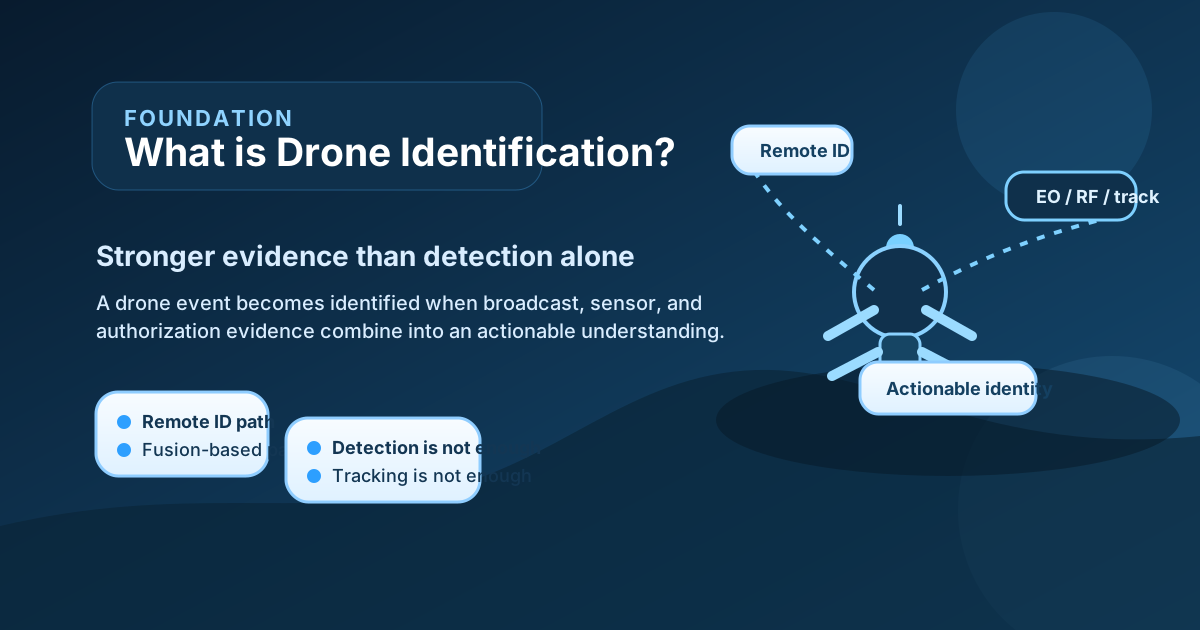
What is drone identification? In simple terms, it means gathering enough evidence to say more than “there is a drone.” Detection tells you that something is present. Tracking tells you where it is moving. Identification asks a stronger question: which drone, which operation, or which cooperative identity is involved, and how confident can the system be about that answer?
That distinction matters because beginners often use detection and identification as if they were interchangeable. In practice they are not. A system may detect a drone by radar, RF sensing, or visual analytics without knowing anything specific about its cooperative identity. A system may track that drone for several minutes without being able to say whether it is authorized, what its serial-related broadcast information is, or who is controlling it. Identification requires stronger evidence than simple presence or movement.
FAA Remote ID material is useful here because it shows what cooperative identification can provide. The FAA explains that Standard Remote ID drones broadcast identifying and location information by radio frequency. But FAA and ARC material also shows the limit of that idea. The UAS Identification and Tracking ARC report notes that reading a registration number on an in-flight aircraft would be nearly impossible at anything beyond very short distance, which is one reason remote identification became operationally important. Together, those points create a practical beginner lesson: drone identification can come from cooperative broadcast, from sensor observation, or from a combination, but those paths do not provide the same kind of certainty or the same kind of detail.
So the short answer is this: drone identification is the process of obtaining enough evidence to associate a drone event with a specific cooperative signal, known object type, or operationally meaningful identity. The important follow-up question is what kind of evidence the identification actually depends on.
What Drone Identification Actually Means
Beginners often expect identification to mean one perfect answer. In real operations, the word can mean several different levels of certainty.
Depending on the workflow, drone identification may mean:
- recognizing that the target is specifically a drone rather than a bird or clutter source,
- associating the aircraft with a Remote ID broadcast,
- obtaining model or manufacturer clues,
- linking the event to a known authorized flight,
- or building enough corroborated evidence for a security or response decision.
This is why identification should be understood as a stronger evidence state, not only as a label. The system is moving from “something is there” toward “we know enough about what it is and what operation it belongs to.”
That also explains why the term can be used differently in different environments. In a consumer-compliance context, identification may emphasize cooperative Remote ID and registration-related information. In a site-security context, identification may emphasize whether the drone belongs to an approved mission or whether the target can be distinguished from non-drone objects. In a counter-UAS workflow, identification may include correlating the aircraft with the controller, operator location, or known flight permission.
For beginners, the safest mental model is this: drone identification means the evidence has progressed beyond detection and toward a specific, actionable understanding of the aircraft or the operation it belongs to.
How Drone Identification Is Different from Detection and Tracking
This is one of the most important distinctions in the topic.
Detection asks whether something is present.
Tracking asks where it is moving over time.
Identification asks what specifically it is, whether it belongs to a known cooperative operation, and whether the system has enough evidence for a stronger operational conclusion.
That means a radar can detect and track a small target without identifying it. An RF system can detect a control link without proving which drone is in the air. A camera can show a target visually without enough detail to connect it to a known authorized mission. These are not failures. They are simply different stages of evidence.
This is why the detection versus identification distinction is so important in low-altitude security. Operators can become overconfident if every alert is treated as though it already contains identity. In reality, the workflow often moves through several steps:
- detect the event,
- track the event,
- classify whether it behaves like a drone,
- and then identify it through cooperative information or stronger corroborating evidence.

Figure: Synthesized explainer showing how drone identification builds on detection and tracking by adding cooperative data or stronger corroborated evidence.
Cooperative Identification: Remote ID and Shared Data
The clearest form of drone identification today is often cooperative identification.
FAA material explains that Standard Remote ID drones broadcast information by radio frequency, and the FAA Remote ID toolkit summarizes the compliance paths for drones and broadcast modules. This matters because a compliant Remote ID signal can provide useful information without forcing a responder to physically read markings from the aircraft itself.
In practical terms, a cooperative identification path may include:
- the drone’s broadcast identity information,
- aircraft location,
- control-station or takeoff-related context depending on the compliance path,
- timestamp and status information,
- and correlation with known approved operations.
That is a strong operational improvement, but it is still important to understand what cooperative identification is and is not.
It is identification because the aircraft is broadcasting information that helps the system distinguish one compliant operation from another. But it is not the same as independent proof of intent, authorization, or safety. A cooperative ID layer is a very useful part of the evidence chain, not a substitute for every other form of situational awareness.
This is one reason FAA and industry discussions keep identification and tracking linked but not identical. A Remote ID-equipped system can help tell who or what is present in a cooperative sense, but the security workflow may still need radar, optical confirmation, airspace context, or operator correlation to understand the full event.
Non-Cooperative Identification: Visual and Sensor Evidence
Not every drone event will offer a clean cooperative signal. That is where non-cooperative identification becomes important.
Non-cooperative identification can rely on several evidence paths:
- optical or EO/IR imagery,
- radar behavior and track characteristics,
- RF signal analysis,
- target kinematics,
- and multisensor correlation.
This is usually more difficult than cooperative identification because the system is trying to infer identity without a friendly self-description.
For example, a camera may show the general shape of a drone, but range, lighting, stabilization, and angle may still prevent a stronger determination. A radar track may show size class, route, and motion cues, but not the same kind of identifying detail that a cooperative broadcast can provide. RF sensing may reveal protocol or emitter characteristics, but not every signal produces a full identity answer.
That is why non-cooperative identification often becomes a fusion problem. No one sensor may be decisive on its own. The system may need to combine:
- track behavior,
- scene imagery,
- RF context,
- known no-fly rules,
- and approved-flight databases.
Only then does the operator reach a strong enough conclusion to treat the target as identified in an operational sense.
Why Remote ID Matters but Does Not Solve Everything
Remote ID is often the most visible identification topic in drone policy discussions, but beginners should not let that narrow the whole subject.
The FAA Remote ID rule exists because traditional physical marking on a fast, small aircraft is not a practical real-time identification method at normal operating distances. The FAA’s UAS Identification and Tracking ARC report states that it would be nearly impossible to read a registration number on a UAS at anything beyond a few feet in many cases. That practical problem helps explain why broadcast-based identification became central.
But Remote ID still has boundaries.
It does not mean:
- every aircraft is cooperative,
- every security event has a usable broadcast,
- every broadcast is enough to resolve the whole operational picture,
- or every identification question reduces to one RF message.
That is why a mature security workflow often uses Remote ID as one layer in a broader identification stack. It is extremely useful when present, but it is not a universal substitute for detection, tracking, or verification.
What Changes Drone Identification Confidence
Several factors determine how strong the identification result really is.
Cooperative Signal Availability
If a compliant Remote ID broadcast is present and can be received clearly, identification can become much easier. Without that, the system must rely more heavily on inference and correlation.
Sensor Quality
Visual confirmation depends on optics, stabilization, range, lighting, and target aspect. RF-based identification depends on signal quality and protocol visibility. Radar-based cueing depends on track quality and separation from clutter.
Fusion Quality
Identification often depends on whether the system can correctly correlate multiple pieces of evidence. A good track plus a good RF event plus the right approved-flight record can create a much stronger answer than any one feed alone.
Scene and Environment
Urban clutter, background traffic, interference, weather, and dense airspace all complicate identification. Even a capable system may produce weaker confidence in a difficult environment.
Workflow and Authorization Context
A drone may be technically identified yet still require operational interpretation. Is it scheduled? Is it inside an approved geofence? Does the cooperative signal match the expected mission? Identification becomes more useful when it is tied to policy and workflow context.
Time
Some events are identified quickly. Others require several seconds or minutes of correlation. A delayed identification may still be useful, but not in the same way as immediate recognition.

Figure: Synthesized factor map showing why identification confidence depends on cooperative broadcasts, sensor quality, data fusion, environment, authorization context, and time.
For beginners, this means identification should be treated as a confidence-based evidence result, not as a simple binary feature.
Common Mistakes
Several misunderstandings appear again and again.
“If the system detects a drone, it has identified the drone”
No. Detection only establishes presence. Identification requires stronger evidence.
“Tracking a drone means we know who it is”
No. Tracking describes movement over time. It does not automatically provide cooperative or specific identity.
“Remote ID solves all identification problems”
No. It is a major cooperative identification layer, but it does not cover every non-cooperative or degraded case.
“Visual confirmation always gives full identity”
No. Range, angle, contrast, and stabilization may support recognition or classification without providing a complete identity answer.
“Identification is one universal standard”
No. The operational meaning of identification can vary by compliance, security, and response context.
What This Means in Practice
For a beginner, the most useful mental model is this: drone identification is the point where the system knows enough to connect a drone event to a more specific operational meaning.
If you are evaluating a system, useful questions include:
- what the system can detect,
- what it can track reliably,
- how it performs cooperative identification through Remote ID,
- what non-cooperative evidence it can add,
- how it fuses approval or authorization context,
- and how it expresses confidence when the answer is incomplete.
Those questions are more useful than simply asking whether the system can “identify drones.” That phrase is too broad unless the evidence path is clear.
This also explains why layered architectures matter in low-altitude security. One layer may detect. Another may track. Another may provide Remote ID or RF context. Another may verify visually. Identification often emerges from the combination, not from one sensor alone.
Conclusion
Drone identification means moving beyond simple presence and toward a specific, actionable understanding of the aircraft or operation involved. It may rely on cooperative broadcast information such as Remote ID, on non-cooperative sensor evidence, or on a combination of both.
The key takeaway is that identification is stronger than detection and different from tracking. A system may detect and follow a drone well without truly identifying it. The best identification workflows combine cooperative data, sensor evidence, and operational context so the team can understand not only that a drone is present, but what that event actually means.