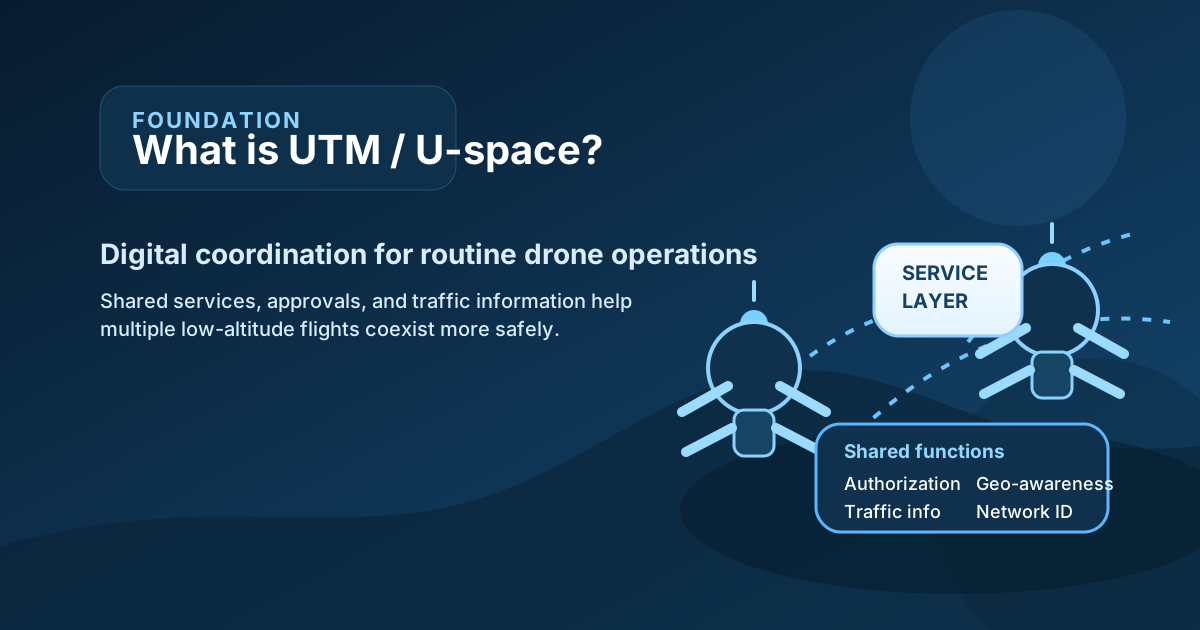
What is UTM or U-space? In plain language, both terms describe the digital systems and operating rules used to coordinate many drone flights safely at low altitude. UTM stands for unmanned aircraft system traffic management. U-space is the European framework that turns that general idea into a defined regulatory and service structure.
The easiest way to understand the topic is to start with the problem it is trying to solve. One or two drones flying in simple conditions can often be managed with local procedures, visual checks, and basic airspace rules. But that approach becomes harder when drone activity grows, when flights move beyond visual line of sight, or when multiple operators share the same low-altitude environment. At that point the system needs more than pilot skill alone. It needs shared digital information, common workflows, and some way to reduce conflict and uncertainty.
That is the space UTM and U-space are trying to fill. They are not just buzzwords for “more drones in the air.” They are attempts to build a safer and more scalable operating environment for routine drone missions. The names differ, and the regulatory details differ even more, but the beginner-level idea is stable: these frameworks help multiple drone operations coexist more safely, especially where classic air traffic control was never designed to manage every small low-altitude flight.
What UTM Means
The FAA describes UTM as a collaborative ecosystem for safely managing drone operations at low altitudes. That definition is helpful because it avoids one common mistake. UTM is not one device, and it is not one vendor console. It is an ecosystem.
That ecosystem depends on several parts working together:
- regulatory rules,
- technical capabilities on the aircraft and in the network,
- service providers,
- operator procedures,
- and data exchange between the different actors who need a shared view of the operating environment.
FAA materials also say that UTM is separate from but complementary to air traffic services. That phrase is one of the most important beginner clues. It means UTM is not simply traditional air traffic control copied downward to 300 or 400 feet. Instead, it is a different coordination model built for a denser, more digital, and more distributed low-altitude drone environment.
In the U.S. concept, UTM supports functions such as flight planning, authorization, surveillance, and conflict management, especially for beyond visual line of sight operations. The same FAA material also notes that the communication model is expected to be highly automated and API-based rather than voice-heavy in the way classic air traffic control often is. That difference matters. UTM is meant to manage volume and complexity through networked data exchange, not by expecting every drone flight to behave like a crewed aircraft talking to a controller on the radio.
What U-space Means
U-space is closely related to the general UTM concept, but it is not just a European translation of the same phrase. In the EASA framework, U-space is a regulatory and service environment defined in law and applied in designated airspace.
EASA explains that the U-space regulations created a framework for unmanned traffic management in Europe. It also explains that a U-space airspace is a geo-zone designated by Member States on the basis of an airspace risk assessment. That detail matters because U-space is not simply “all drone airspace in Europe.” It applies in designated airspace where the risk picture justifies that service structure.
EASA also lists the mandatory services that U-space service providers deliver in U-space airspace:
- UAS flight authorization,
- geo-awareness,
- network identification,
- and traffic information.
Those services already show what U-space is trying to do. It is giving operators a managed digital environment where approvals, constraint awareness, live identification, and traffic context are handled through a coordinated service framework. In other words, U-space is not just a policy slogan. It is a service model with named actors, named responsibilities, and designated airspace.
Why Drone Traffic Management Is Needed at All
Beginner readers often ask a fair question: why is any of this necessary? Why not just keep using existing drone rules and basic separation?
The short answer is scale. As soon as drone operations become more frequent, more automated, or more commercially important, the system needs better coordination than ad hoc visual avoidance and isolated pilot judgment can provide.
Several situations make that obvious:
- many drones sharing the same urban or industrial area,
- repeated logistics or inspection missions,
- public-safety operations that need priority access,
- flights beyond visual line of sight,
- and mixed environments where drones and manned aircraft may both need awareness of each other.
NASA’s UTM project framed the issue this way: research was needed to make it possible for small unmanned aircraft systems to safely access low-altitude airspace beyond visual line of sight. That is a useful beginner summary because it links the technology question to the operational one. The real challenge is not merely “can drones fly?” The challenge is “how do many legitimate drone operations happen routinely, with less uncertainty and less conflict?”
What Services UTM or U-space Usually Includes
Not every jurisdiction packages services the same way, but the core service logic is similar enough that beginners can learn it as a common pattern.
Most UTM-style ecosystems include some combination of:
- digital flight planning,
- authorization or approval workflows,
- airspace and geo-zone awareness,
- network-based identification or tracking inputs,
- conflict detection,
- traffic information sharing,
- and interfaces with public authorities or conventional aviation systems.
That list is more useful than a dictionary definition because it shows what these systems actually do. They reduce uncertainty before flight, during flight, or both.
Before flight, they help answer questions such as:
- Is this route allowed here?
- Does this operator have the right approval path?
- Are there temporary constraints or geo-zones to respect?
- Does the mission conflict with planned activity from someone else?
During flight, they help answer a different set of questions:
- Is the aircraft where it is supposed to be?
- Is another aircraft entering the same space?
- Is a manned aircraft nearby?
- Has the operation changed enough that someone needs to intervene or reroute?
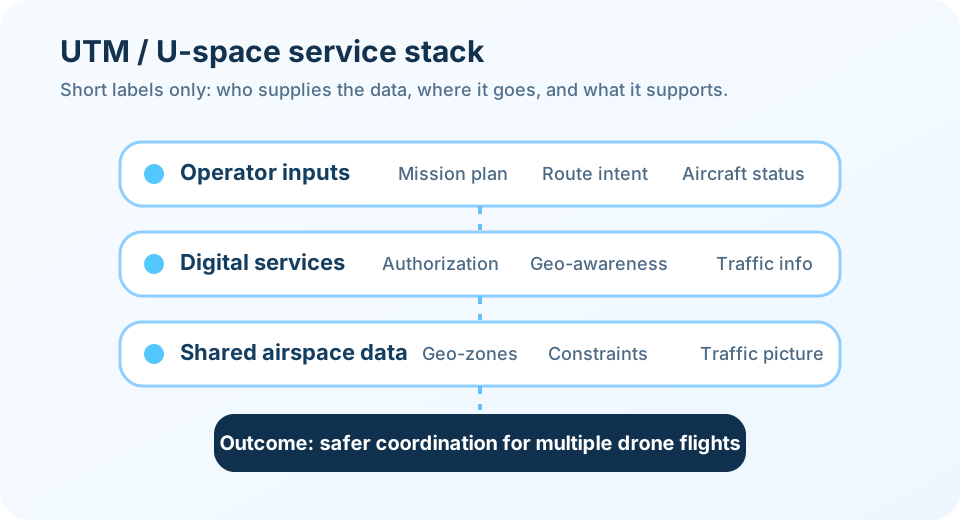
Figure: Synthesized service-stack diagram showing how operator planning, service-provider functions, and shared airspace data combine into a UTM-style workflow.
That service view is also the clearest way to distinguish UTM from a normal map or tracking dashboard. A dashboard can display information. UTM and U-space go further by structuring how information is exchanged and acted on across multiple participants.
UTM or U-space Is Not the Same as Air Traffic Control
One of the most common misunderstandings is the belief that UTM is just “air traffic control for drones.” That is not quite right.
Traditional air traffic control was designed around crewed aviation, structured communications, and a different density and risk model than the one expected for many small unmanned aircraft operating at low altitude. UTM and U-space are meant to be more distributed and more automated. FAA materials explicitly say the primary means of coordination is through highly automated systems and APIs rather than pilot-to-controller voice communications.
That does not mean the two worlds are unrelated. FAA guidance says UTM is complementary to air traffic services, and EASA’s U-space framework includes interfaces with manned aviation and conventional air traffic control where needed. The right mental model is not “replacement.” It is “coordination between different airspace-management layers.”
This distinction matters in practice. If a beginner expects UTM to work exactly like conventional ATC, they may imagine a central controller directly managing every drone movement in real time. That is usually too simplistic. The actual model is more distributed. Operators, service providers, regulators, and in some cases conventional aviation stakeholders all contribute information and constraints. The system is closer to a managed digital ecosystem than to one tower talking to every aircraft by voice.
How Remote ID Fits In
Remote ID and UTM are related, but they are not interchangeable.
Remote ID is one enabling layer. It helps provide a cooperative identity and location signal for drones in flight. UTM or U-space uses broader services to coordinate operations, constraints, approvals, and traffic relationships.
The relationship becomes clearer when you separate the questions:
- Remote ID helps answer: who is this drone, and where is it?
- UTM or U-space helps answer: how should multiple operations be organized safely in shared airspace?
That is why public guidance often presents Remote ID as groundwork rather than as the whole solution. Without a cooperative identification layer, large-scale traffic management becomes harder. But even with Remote ID in place, the ecosystem still needs approvals, constraint data, traffic information, operator responsibilities, and service-provider workflows. A drone broadcasting identity is not the same as a mature traffic-management environment.
The Key Actors in a U-space Environment
The European U-space framework is useful for beginners because it makes the actors explicit.
EASA identifies several major participants:
- Member States, which designate U-space airspace after risk assessment,
- national authorities or EASA, which certify relevant providers,
- U-space service providers, or USSPs,
- common information service providers, or CISPs,
- UAS operators,
- and manned aviation participants where applicable.
That actor model is valuable even outside Europe because it teaches the right systems lesson: drone traffic management is not only about aircraft. It is about responsibilities.
A U-space service provider helps deliver the operational services that operators use. A CISP helps distribute the static and dynamic information that makes those services possible. Member States and authorities decide where the structure applies and who may provide it. Operators still remain responsible for their flights. This is an important beginner point. A traffic-management framework can support safe operations, but it does not erase operator responsibility.
How U-space Differs From the Older SESAR U1 to U4 Vision
If a beginner reads enough online material, they will encounter the terms U1, U2, U3, and U4. These came from the SESAR U-space blueprint as staged service levels:
- U1 for foundation services such as e-registration, e-identification, and geofencing,
- U2 for initial services such as flight planning, approval, and tracking,
- U3 for more advanced conflict-management and automation support,
- and U4 as a much more fully automated future state.
This is still useful as a maturity model, but beginners should not confuse that conceptual roadmap with the currently applicable mandatory service set in every European context. The SESAR staging language explains how the ecosystem was imagined to evolve. The EASA regulatory framework explains what is actually required in designated U-space airspace today.
That distinction matters because many introductory discussions accidentally mix visionary architecture with current operational obligation. For a beginner, the safest rule is this: read U1 to U4 as the historical roadmap language, and read the EASA mandatory-service description as the operationally relevant current framework.
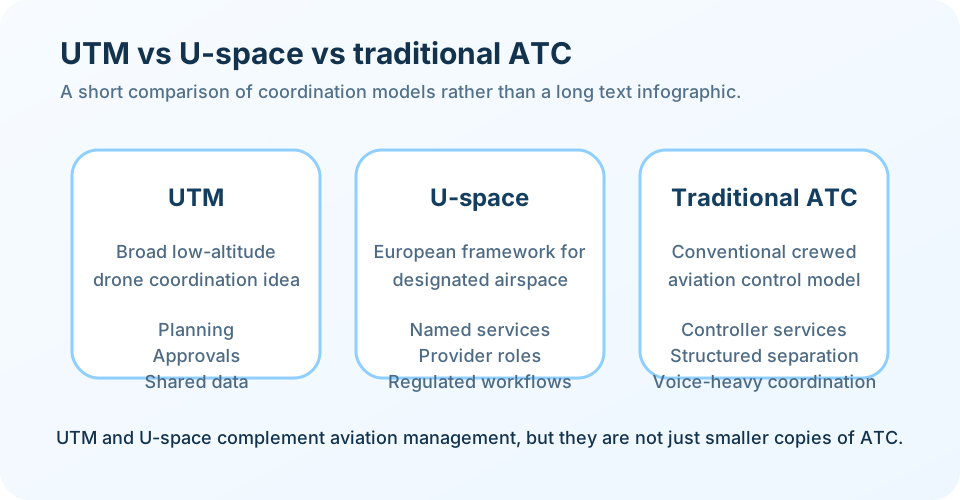
Figure: Synthesized comparison showing why UTM and U-space should be treated as digital coordination ecosystems rather than as simple copies of conventional ATC.
Common Misunderstandings About UTM and U-space
Several misconceptions appear again and again.
“UTM is just one software platform”
No. UTM is an ecosystem concept. Any one platform may provide part of the workflow, but the idea itself includes rules, services, interfaces, and shared responsibilities across many actors.
“U-space is simply the European word for UTM”
Not exactly. U-space is related to the general UTM idea, but it is a specific European regulatory and service framework for designated airspace, with named services and provider roles.
“Remote ID and UTM are basically the same thing”
No. Remote ID is one identification layer. UTM or U-space is the broader coordination environment around planning, approvals, constraints, and traffic relationships.
“UTM means drones will be treated exactly like manned aircraft”
No. UTM is meant to support drone integration, but usually through a more distributed and digital coordination model than classic voice-based air traffic control.
“Once UTM exists, airspace conflicts disappear”
No. These frameworks reduce risk and improve coordination, but they do not eliminate weather, bad planning, non-compliance, incomplete coverage, or the need for operator judgment. The system can improve safety without making the environment frictionless.
What This Means in Practice
If you are new to the topic, the most practical mental model is this: UTM and U-space are coordination frameworks for routine drone operations at scale.
They matter when the operating environment becomes busy enough or complex enough that isolated pilot decisions are no longer sufficient. They matter even more when operations expand into beyond visual line of sight missions, shared urban corridors, inspection networks, logistics routes, or public-safety scenarios where multiple actors need the same airspace picture.
They also matter because they separate two questions that beginners often mix together. One question is whether a drone can fly at all under the local rules. The other is whether many different drone flights can coexist safely and efficiently in the same airspace. UTM and U-space focus more on that second question.
Conclusion
UTM is the broader idea of digitally coordinating drone operations at low altitude. U-space is the European regulatory and service framework that applies that idea in designated airspace. Both exist because routine drone activity needs more structured coordination than simple line-of-sight flying and isolated local procedures can provide.
The key takeaway is that these frameworks are not just about watching drones on a screen. They are about planning, permissions, data exchange, traffic awareness, and shared responsibility. If Remote ID helps answer who and where, UTM and U-space help answer how many drone operations can happen safely in the same low-altitude environment.