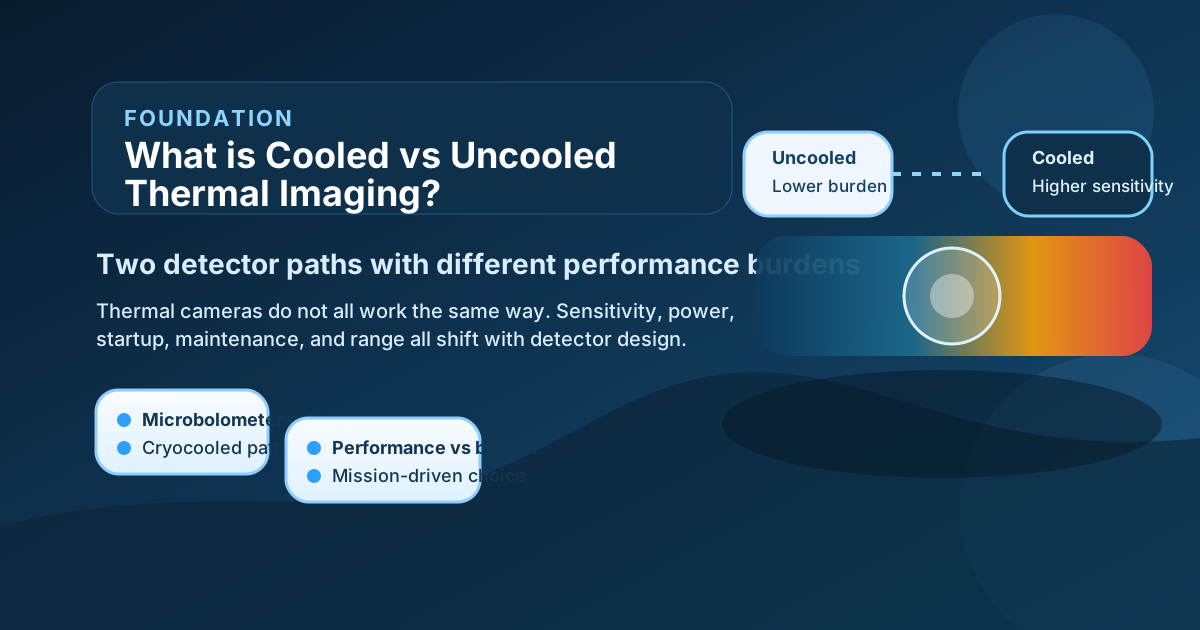
What is the difference between cooled and uncooled thermal imaging? In plain language, both are forms of thermal imaging, but they use different kinds of infrared detectors and therefore behave differently in the field. Uncooled thermal cameras usually rely on microbolometer sensors that measure heat-induced changes inside the detector itself. Cooled thermal cameras use detector assemblies that are actively chilled to very low temperatures so they can measure very small infrared signals with higher sensitivity.
That sounds technical, but the beginner question behind it is simple: if both can produce a thermal image, why do professionals still distinguish them so carefully? The answer is that the detector design affects much more than the image on screen. It affects startup time, sensitivity, long-range performance, maintenance, power demand, cost, and how well the camera fits a particular mission.
FLIR explains this difference directly in its technical material. Its cooled-versus-uncooled guidance says uncooled systems commonly use microbolometers, while cooled systems use a cryocooler to lower the sensor temperature so noise falls below the scene signal, increasing sensitivity. FLIR’s marine guidance then shows the operational consequence: a cooled thermal system can deliver stronger long-range performance, but it also brings higher complexity, power demand, and cost. That is the right beginner framing. This is not a simple good-versus-bad comparison. It is a trade-off between performance and system burden.
So the short answer is this: cooled and uncooled thermal imaging both detect infrared energy, but they do it with different detector architectures, and those architectures create different strengths, limits, and deployment choices.
What Uncooled and Cooled Thermal Imaging Mean
Start with the most basic distinction.
An uncooled thermal camera usually uses a microbolometer. FLIR explains that a microbolometer is a thermal-based detector whose resistance changes when heated or cooled by incoming infrared radiation. The lens focuses infrared energy onto detector elements. Each element corresponds to a pixel. The sensor measures how much the element changes and converts that into the thermal image.
A cooled thermal camera works differently. FLIR describes cooled cameras as collecting photons of infrared energy, converting them into electrons, and reading them out after an integration period. The detector is coupled with a cryocooler that lowers the sensor to cryogenic temperature so detector noise drops far below the scene signal. That lower noise floor is the reason cooled systems can become much more sensitive.
This difference matters because the two systems are not just two versions of the same component. They solve the infrared-imaging problem with different design philosophies.
In simple terms:
- uncooled systems favor simplicity, lower power, and lower cost,
- cooled systems favor sensitivity and higher-end performance,
- and the correct choice depends on what the mission really needs.
That is why a buyer should never assume that the word thermal tells the whole story. Two cameras may both be thermal, yet belong to very different operational categories.
How the Two Sensor Types Work
The easiest way to understand the difference is to think about what the detector is being asked to measure.
An uncooled microbolometer measures the heating effect of incoming infrared radiation on the detector element. FLIR’s explanation is useful here because it shows that the process is based on resistance change at the detector pixel. That is why uncooled cameras can be simpler and more practical for many deployments. They do not require the same active cooling hardware and can often be used in more compact, lower-power packages.
A cooled detector, by contrast, is designed to measure very small infrared signals with much higher sensitivity. The cryocooler is the critical part. FLIR notes that it cools the detector to around 77 K in one example, which greatly reduces thermal noise. Once the detector noise is pushed lower than the signal from the scene, the system can separate subtler thermal differences and support more demanding imaging tasks.
That difference in detector physics is what drives so many downstream trade-offs:
- sensitivity,
- range,
- ability to separate weak temperature contrast,
- frame rate potential,
- power consumption,
- startup behavior,
- and maintenance burden.

Figure: Synthesized explainer showing how uncooled microbolometer systems and cooled cryogenic detector systems follow different sensing paths and support different performance envelopes.
For beginners, this is the important takeaway: the distinction is not merely a product label. It comes from the way the sensor itself works.
Why the Difference Matters in Real Use
If the discussion stopped at detector physics, it would not help many buyers or planners. The practical value is understanding what those detector differences change in the field.
Sensitivity and Contrast
Cooled systems are generally more sensitive. FLIR states this directly, noting that cooled cameras are more sensitive and more expensive than uncooled cameras. Greater sensitivity helps when the mission depends on resolving subtle thermal contrast or seeing farther with more confidence.
Long-Range Performance
Long-range surveillance is one of the clearest reasons cooled systems remain important. FLIR Marine’s guidance explains that cooled thermal cameras can outperform high-end uncooled cameras in fog and haze conditions and can extend detection and classification range significantly. That does not mean every cooled system is automatically superior in every situation, but it does show why long-range maritime, border, and high-threat observation roles often keep cooled systems in the discussion.
Startup and Operational Tempo
Uncooled systems are often easier to bring online because they do not depend on the same cooling cycle. In practical use, that can matter when the system is expected to run simply and consistently or be powered on with minimal delay. Cooled systems can demand more preparation and support around startup, stabilization, and sustained operation.
Power, Size, and Support Burden
FLIR notes that the cryocooler in a cooled camera draws more power and eventually wears out. That is a major planning issue. A system may deliver excellent performance, but the platform carrying it must still support the power load, weight, maintenance cycle, and replacement cost.
Lifecycle Cost
Uncooled systems are often lower cost to buy, easier to maintain, and more practical for wider deployment. That does not make them “entry-level only.” It simply means they often fit programs where 24/7 operation, simpler logistics, or broader site coverage matter more than extreme sensitivity.
What Changes Which One You Should Choose
Beginners often ask which type is better. The more useful question is which type fits the mission.
Detection Range and Identification Need
If the mission demands very long-range awareness, higher contrast sensitivity, or stronger classification at distance, cooled systems often become more attractive. If the mission is shorter-range site monitoring, general thermal awareness, or cost-controlled deployment at multiple positions, uncooled may be the more practical fit.
Duty Cycle and Sustainment
A site that needs many fixed thermal viewpoints operating continuously may value the lower support burden of uncooled cameras. A specialized overwatch or high-value tracking role may justify the complexity of a cooled system because the performance gain supports the mission directly.
Platform Constraints
Small mobile systems, unattended stations, and lower-power installations may not welcome the added burden of a cryocooler. In other cases, the platform may already be sized for a heavier, higher-power payload and can support a cooled unit more comfortably.
Environment
Maritime observation, long corridors, and certain degraded-visibility conditions can push cooled systems higher on the list because sensitivity and range matter more there. Dense site surveillance at moderate range may not justify that complexity.
Budget and Fleet Size
One premium cooled payload and ten uncooled payloads do not solve the same operational problem. Planning should therefore consider coverage architecture, not just unit performance. In some deployments, more viewpoints with simpler sensors create better overall awareness than one high-end system.
Human Workflow
The human task matters too. Does the operator need:
- early detection,
- reliable verification,
- long-range classification,
- or simply a thermal layer that continues working when visible imagery degrades?
Those are not the same requirement, so they should not drive the same detector choice automatically.

Figure: Synthesized factor map showing why mission range, sustainment, platform limits, environment, budget, and operator workflow all shape detector choice.
The beginner takeaway is that selection should start from the mission, then move to the detector, not the other way around.
Cooled Does Not Automatically Mean Better
This is one of the most common misunderstandings.
Because cooled systems are often more sensitive and more expensive, people sometimes assume they are simply the better option. That is too simplistic.
A cooled system may be a poor fit if:
- power availability is limited,
- maintenance simplicity matters,
- many observation points are needed,
- startup and support burden must stay low,
- or the mission does not require the extra sensitivity.
In those cases an uncooled system may actually be the better engineering choice because it fits the deployment reality more honestly.
The reverse misunderstanding also happens. People sometimes assume uncooled systems are only a compromise. That is also inaccurate. Uncooled thermal cameras are widely used because they solve many real problems well: persistent monitoring, general night awareness, lower-cost thermal coverage, and simpler integration into fixed or mobile systems.
So the right way to think about the topic is not premium versus basic. It is fit versus misfit.
Common Mistakes
Several mistakes appear again and again.
“Thermal is thermal, so detector type does not matter”
No. Detector type changes sensitivity, support burden, power needs, and mission suitability.
“Cooled always gives the best answer”
No. It often gives higher performance, but the added complexity may be unnecessary or even undesirable in many deployments.
“Uncooled means low quality”
No. Uncooled systems can be highly effective for many security and awareness tasks, especially where simplicity and continuous use matter.
“A better detector removes all interpretation limits”
No. Even a strong thermal system still depends on range, optics, atmosphere, target contrast, and operator interpretation.
“Selection should start from the sensor brochure”
No. It should start from the operational question: what needs to be detected, verified, classified, and sustained over time?
What This Means in Practice
For a beginner, the best mental model is this: cooled and uncooled thermal imaging are two different ways to build a thermal sensing layer, and each carries a different operational package.
If you are planning a system, useful questions include:
- how far the target needs to be seen,
- what level of contrast sensitivity is required,
- how quickly the system must be ready,
- what power and maintenance burden the platform can support,
- how many viewpoints the site needs,
- and whether the mission rewards extreme performance or broad practical coverage.
Those questions usually reveal the answer more clearly than asking which technology is more advanced.
This also explains why many mature systems mix layers. A site may use uncooled thermal cameras for broad persistent coverage and reserve cooled systems for specialized long-range or high-value observation tasks. The best architecture is often not about choosing one label forever. It is about using the right detector where its strengths matter most.
Conclusion
Cooled and uncooled thermal imaging both turn infrared energy into usable images, but they do it with different detector architectures. Uncooled systems commonly use microbolometers and emphasize simplicity, lower power, and lower lifecycle burden. Cooled systems use cryogenic cooling to reduce detector noise and deliver higher sensitivity for more demanding tasks.
The key takeaway is that the right choice depends on mission fit. If the job depends on long-range performance, subtle thermal contrast, or more demanding imaging conditions, cooled systems may be justified. If the goal is practical, persistent thermal awareness with lower complexity and broader deployment potential, uncooled systems are often the better answer. The correct decision comes from the mission, not from the label alone.