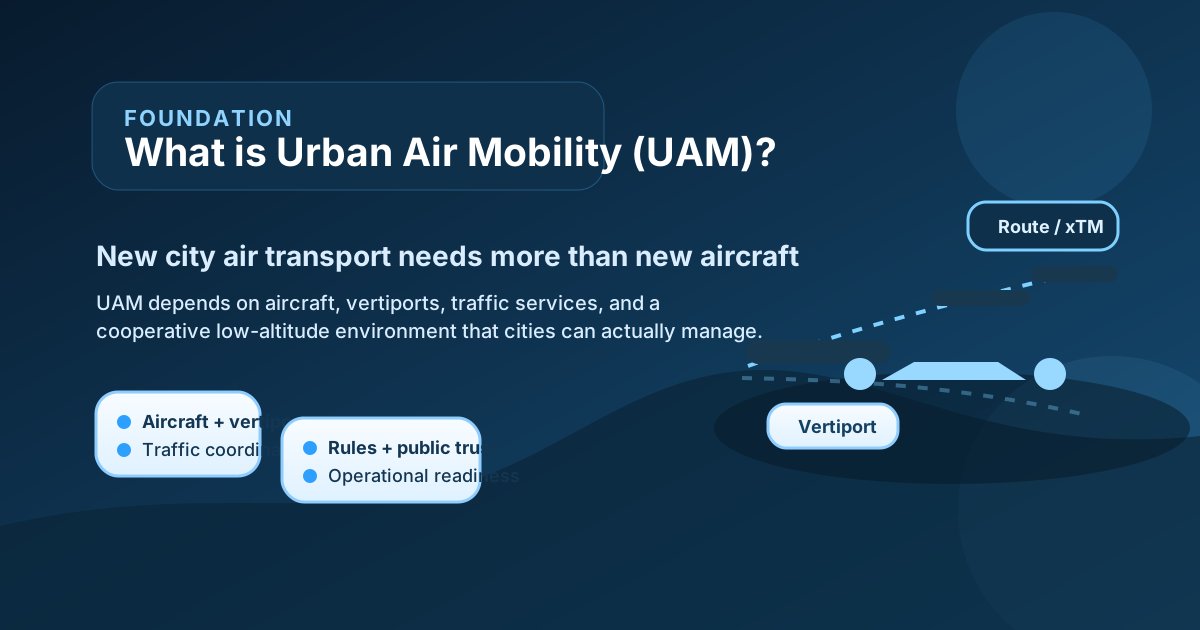
What is urban air mobility? In simple terms, urban air mobility, usually shortened to UAM, means using aircraft to move passengers or cargo in and around cities in a new, more integrated way. Instead of thinking only about traditional helicopters or small airplanes, UAM usually refers to newer aircraft concepts, digital traffic-management support, and specialized infrastructure designed for dense urban or peri-urban operations.
The idea has become more visible because aviation regulators and research agencies have been preparing for it. EASA describes UAM as a new, safe, secure, and more sustainable air transportation system for passengers and cargo in urban environments, enabled by new technologies and integrated into multimodal transportation systems. The FAA explains that UAM is a subset of Advanced Air Mobility, or AAM, and treats it as a future operational environment involving passenger or cargo-carrying operations in and around urban areas. These are useful official definitions because they show that UAM is not just “flying cars.” It is a system concept involving aircraft, infrastructure, operations, and traffic coordination.
That systems view matters for beginners. People often imagine only the vehicle: a quiet electric vertical takeoff aircraft moving between rooftops. But a real UAM environment also needs landing sites, charging or support facilities, communications, route management, cooperative traffic behavior, and public trust. Without those, the aircraft is only one promising prototype, not a working mobility system.
So the short answer is this: UAM is a city-focused air transportation concept using new aircraft and digital coordination to move people or goods in and around urban areas. The practical question is what has to exist around the aircraft for that concept to work safely and routinely.
What UAM Actually Means
At the beginner level, UAM is easiest to understand as an urban-use case inside the larger AAM landscape.
The FAA’s Concept of Operations says UAM is a subset of Advanced Air Mobility. The FAA’s infrastructure page describes AAM as an umbrella term for aircraft that are typically highly automated, electrically powered, and capable of vertical takeoff and landing, often associated with air-taxi concepts. EASA takes a similarly broad but urban-centered view by defining UAM as a transport system for passengers and cargo in urban environments using electric aircraft that take off and land vertically, remotely piloted or with a pilot on board.
Those official descriptions reveal three important beginner points.
First, UAM is about transport in and around cities, not just about aircraft technology.
Second, UAM is usually discussed as a system that includes both passenger and cargo uses.
Third, UAM is closely tied to new entrants in low-altitude airspace, especially vertical-takeoff or powered-lift aircraft and the digital services needed to manage them safely.
That is why UAM should not be reduced to a single vehicle type. Many people picture eVTOL aircraft, and that is reasonable because they are central to most UAM discussion. But the broader operational meaning includes the routes, infrastructure, coordination services, and regulatory framework that make those aircraft usable in cities.
How UAM Fits Inside Advanced Air Mobility
One of the most common beginner confusions is the relationship between UAM and AAM.
The FAA treats UAM as a subset of AAM. That means AAM is the broader umbrella, while UAM is the urban-focused part of that umbrella. AAM can include more than passenger trips inside a city. It can also include cargo transport, emergency support, rural or regional routes, and other new-aircraft use cases.
UAM, by contrast, narrows attention toward the urban and peri-urban environment. This changes the operational problem because cities bring:
- denser infrastructure,
- more people on the ground,
- more constrained takeoff and landing sites,
- more sensitivity to noise and public acceptance,
- and more pressure for digital coordination with existing transport systems.
The FAA UAM Concept of Operations also introduces the idea of a cooperative operating environment supported by Extensible Traffic Management, or xTM, which complements traditional Air Traffic Services. That is a useful way to think about UAM: not as a free-for-all in city skies, but as a coordinated environment where many aircraft and service actors have to behave predictably.
For beginners, the safest mental model is:
AAMis the broader future-air-mobility family,UAMis the city-focused transport segment within it.
What a Working UAM System Needs
A real UAM system needs more than an aircraft that can lift off vertically.
The FAA infrastructure page is helpful here because it explains that early AAM operations will use existing infrastructure such as airports and heliports where possible, but that new facilities like vertiports and vertistops are also expected. The same page defines a vertiport as an area of land, water, or structure intended to support landing, takeoff, taxiing, parking, and storage of powered-lift aircraft or other aircraft that fit approved performance standards.
That means a working UAM system usually depends on at least five layers:
- aircraft,
- places to land and operate,
- communications and navigation support,
- traffic-management logic,
- and operating rules that people and regulators trust.
The aircraft are the visible part, but the infrastructure and coordination layers are what allow operations to scale. A one-off demonstration flight proves a vehicle can fly. A mobility system requires predictable departures, arrivals, turnaround, routing, separation, and emergency handling.
This is why the FAA and EASA both talk about UAM in system terms rather than only in aircraft terms. The operational environment matters just as much as the vehicle.

Figure: Synthesized explainer showing how aircraft, vertiports, traffic-management services, operators, and city infrastructure combine to create an urban air mobility system.
Why Traffic Management Matters So Much
One reason UAM draws so much attention is that it is not only an aircraft-integration problem. It is a traffic-management problem.
The FAA UAM Concept of Operations explains that the UAM vision is supported by a cooperative operating environment known as Extensible Traffic Management, or xTM. This complements traditional Air Traffic Services for future passenger or cargo-carrying operations. That line matters because it shows regulators do not expect urban low-altitude traffic simply to fit into old airspace processes unchanged.
For beginners, this means UAM depends on digital coordination. Aircraft operators, ground facilities, route services, approvals, and airspace constraints all have to work together more dynamically than in many traditional aviation workflows.
That is why UAM is closely related to:
- UTM or U-space style service concepts,
- cooperative identification,
- routing and deconfliction,
- real-time information sharing,
- and shared operating rules for new entrants.
This does not mean every UAM aircraft is just a large drone. It means that many of the same low-altitude traffic-management questions become more important when you add repeated urban operations.
Why UAM Is Harder Than It Looks
Beginners often see the aircraft renderings first and underestimate the rest of the system challenge.
Several issues make UAM difficult:
Infrastructure
You need safe takeoff and landing sites, passenger or cargo handling logic, support equipment, and in many cases new types of vertiport planning. The FAA infrastructure guidance makes clear that facilities themselves are a significant part of the problem.
Airspace Integration
Urban areas already contain airports, heliports, drone operations, restricted areas, emergency flights, and complex obstacle environments. Adding regular UAM operations increases the need for reliable coordination.
Safety and Certification
Aircraft, operators, software, communications, and procedures all need certification and oversight pathways that regulators can support at scale.
Public Acceptance
EASA’s UAM materials emphasize that citizen acceptance and trust are essential to successful deployment. This is a major beginner point because a technically feasible aircraft does not automatically become a socially accepted transport system.
Security and Monitoring
More cooperative low-altitude traffic also means more need for identification, authorized-flight awareness, and differentiation between approved operations and suspicious flights. That changes the job for security and monitoring systems.
Economics
Even if the aircraft flies well, the total operating model must still make sense. Fleet size, turnaround, vertiport utilization, staffing, energy or charging cycles, and route demand all influence whether UAM is practical.
What UAM Means for Low-Altitude Monitoring and Security
This is where the topic becomes especially relevant to security and airspace-awareness teams.
A future UAM environment changes the low-altitude picture in at least three ways.
First, it increases legitimate traffic density in some corridors or urban operating zones. That means the monitoring problem becomes less about detecting any airborne object and more about distinguishing authorized, scheduled, and cooperative operations from abnormal ones.
Second, it increases the value of shared digital context. If more aircraft are flying with formal routing, approved operations, and cooperative identification, then surveillance and command systems need stronger correlation between:
- what is detected,
- what is authorized,
- and what should be happening at that time and place.
Third, it increases the importance of response logic. When more cooperative aircraft are present, a security workflow has to avoid treating every target as a threat while still recognizing genuine anomalies quickly.
This is why UAM is not only an aviation innovation topic. It is also a monitoring, traffic-awareness, and operational-coordination topic.
Common Mistakes
Several misunderstandings appear again and again.
“UAM just means flying cars”
No. UAM is a transport system concept, not just a futuristic vehicle image.
“UAM and AAM are the same thing”
Not exactly. UAM is usually treated as a subset of the broader AAM effort.
“If the aircraft is ready, UAM is ready”
No. Vertiports, communications, traffic management, approvals, and operating procedures are all part of readiness.
“UAM is only for passenger air taxis”
No. Official descriptions also include cargo and other urban or peri-urban service uses.
“UAM is only an aviation topic”
No. It also affects cities, infrastructure planners, monitoring systems, traffic management, and public acceptance.
What This Means in Practice
For a beginner, the most useful mental model is this: UAM is a city mobility system built around new aircraft, not a single aircraft product category.
If you are evaluating UAM-related systems or policy, useful questions include:
- what type of operation is being discussed,
- what infrastructure supports it,
- how aircraft will be coordinated,
- what cooperative information is available,
- how authorized traffic will be distinguished from abnormal traffic,
- and whether public, regulatory, and operational trust exist around the concept.
These questions are more useful than asking only whether an aircraft can take off and land vertically.
This also explains why UAM is so tightly connected to digital traffic-management and low-altitude awareness tools. As operations become more routine, the challenge shifts from proving flight is possible to proving that repeated urban operations can be managed safely, predictably, and visibly.
Conclusion
Urban air mobility is a city-focused air transportation concept using new aircraft, supporting infrastructure, and digital traffic coordination to move people or cargo in and around urban areas. It is usually treated as a subset of Advanced Air Mobility and depends on much more than the aircraft itself.
The key takeaway is that UAM is a system problem. Aircraft, vertiports, traffic management, cooperative operations, public acceptance, and monitoring all have to work together. If those layers do not mature together, UAM remains a demonstration. If they do, it becomes a new low-altitude mobility environment that cities, operators, and security systems all have to understand.